By Ashlyn N. Ramirez


“Justice is possible without a knowledge of God’s Law.” — Alasdair MacIntyre
“Struggles for recognition occur in a world of exacerbated material inequality.” — Nancy Fraser

We like to think justice is simple. Fair. Earned. But what if the systems we rely on to define justice were never built for everyone in the first place?

In my studies, I found myself pulled between two powerful voices: Alasdair MacIntyre and Nancy Fraser. They don’t write textbooks. They write blueprints for understanding who gets to decide what’s fair—and who’s left out.

MacIntyre speaks in traditions. He says justice is shaped by culture, by religion, by inherited values. Justice, for him, isn’t universal—it’s rooted in communities shaped by Puritanism, Catholicism, and Judaism. If those are the traditions you’re part of, maybe his logic feels familiar. But for others, it can feel exclusive. It left me wondering: if your history isn’t part of those narratives, do you still get to belong?

Fraser, on the other hand, meets us in the present. She writes about what we can see: food insecurity, health gaps, systemic racism, and gender-based violence. Her lens is urgent, intersectional, and sharp. She says it’s not enough to redistribute wealth—you must also recognize identity. You can’t discuss equality without addressing visibility.


When Tradition Doesn’t See You

MacIntyre’s work made me pause. He believes we inherit rationality through community. That truth is shaped by tradition. The liberal media and secular politics have lost sight of deeper values. He’s not entirely wrong.

However, I don’t come from the traditions he centers on. And I don’t believe justice should be reserved only for people who follow a specific moral lineage. Justice, to me, can’t be something you earn through inheritance. It has to be something we build—together.

Irene Chu calls MacIntyre’s logic deeply institutional. He’s focused on structure. On moral blueprints. But I kept asking myself: what about people who are navigating systems that were never made with them in mind?


Seeing Ourselves in the Struggle

Fraser is different. She calls out material inequality—not just in paycheck size, but in access to healthcare, housing, and even clean air. Her work hit home. As someone who has lived through environmental racism and felt the physical cost of inequality, her ideas weren’t just theory. They were familiar.

Fraser argues for two kinds of justice: redistribution (who gets what) and recognition (who gets seen). She says you can’t have one without the other. Pride parades, she notes, aren’t just celebrations—they’re statements. Visibility is political.

She also doesn’t let systems off the hook. Fraser is critical of neoliberalism, identity tokenism, and top-down reform. She’s grounded in feminist theory and understands that structural change requires cultural and symbolic transformation too.


Where They Meet—and Where They Don’t

Both MacIntyre and Fraser believe justice isn’t working. But their solutions come from different places. One looks to the past; the other looks to systems and structures that still dominate the present.

They both criticize liberalism’s failures. Both challenge how Enlightenment ideals left out too many people. But only one of them, in my opinion, shows a path forward that includes all of us.

MacIntyre invites us to consider what we inherit. Fraser challenges us to change what we’ve normalized.


Why It Matters to Me

As a doctoral student researching the digital divide, I witness these frameworks being played out every day. Some students never had access to laptops or high-speed internet. That’s not just a tech issue—it’s a justice issue. Fraser’s lens helps me see that clearly.

But I also understand how culture shapes belief. That’s MacIntyre’s territory. Why some still resist digital learning. Why access isn’t just about money, but mindset.

Ultimately, both theorists provide tools. Fraser equips me to fight for equity. MacIntyre reminds me that beliefs are inherited—and that means they can be challenged.


Justice Isn’t Neutral. It’s Personal.

I’ve spent years trying to understand why justice seems so distant for some and so readily assumed for others. This journey through MacIntyre and Fraser didn’t provide me with a single perfect answer. But it gave me a better question:

Whose justice? Which rationality?

I think we’re all still trying to figure that out.


Ashlyn N. Ramirez is a doctoral candidate, writer, and researcher who explores media, identity, and access in the digital age.

Written in 2023

“Go back to where you came from.” That was the top phrase I heard the entire time I’ve been a resident of the California Bible Belt.

There’s nothing original about growing up in the Inland Empire. It’s the suburbs—yet somehow still considered rural in parts. It’s a place where underrepresented populations are growing in number, but so are Trump flags and right-wing extremism.

In 2020, Riverside County—where I reside—declared racism a public health crisis. But racism has always been here. It’s in the air, in the politics, and sometimes literally in the air—I developed severe asthma from poor air quality, a byproduct of environmental racism. I once lived next to a house raided by the FBI for extremist activity. My local representative, Ken Calvert, welcomed Congresswoman Marjorie Taylor Greene to attend a church service in my community—during a tour with indicted rapist Congressman Matt Gaetz.

It’s the kind of place where, in 2014, “patriots” blocked a road with linked arms to stop a bus of Central American immigrants, convinced they were defending land that was never theirs to begin with. This community sits on stolen land—look up the Temecula Indian Massacre.

And I live here.


Assimilation Is Not Safety

Being multigenerational doesn’t shield me from anything. I still live with my parents after my divorce. I still face systemic oppression—in healthcare, in schools, and in the workplace. I’ve spent half my life trying to break into a profession that doesn’t want me there. Not here. Not where my presence is questioned at every turn.

At 28, I took a DNA test and discovered I’m Indigenous. But I don’t know what tribe I came from. That’s erasure. That’s trauma. That’s assimilation. And no amount of “blending in” will save us.


Journalism Was Never Just a Job

I built a journalism career piece by piece. Assistant Opinion Editor at Cal State Fullerton’s Daily Titan. Reporter. Editor. Columnist. I investigated homelessness in Orange County and covered political unrest. In 2017, I helped cover a CSUF lecturer’s altercation with the campus Republican club and the protests that followed. That work resurfaced recently—because the threats haven’t gone away.

I’ve written for luxury magazines, indie rock blogs, and newspapers across Southern California. I helped de-platform a right-wing extremist on The Intercept. My team placed third in the California College Media Awards and was a finalist for the LA Press Club. I was proud. But even with those wins, self-doubt lingered—because race and class constantly press back.

I have two degrees, including a Master of Science in Communications and Journalism Innovation, and I’m earning a doctorate in Education. But even now, I know what it means to be overlooked.


Beyond DEI

Diversity, equity, and inclusion have become marketing buzzwords. DEI can be a trap—another way to tokenize BIPOC voices instead of truly listening.

I used to think my passion was journalism. But what I’ve come to realize is that my real passion is learning. It’s education. It’s digital literacy. It’s helping others navigate a world built to exclude them. I’m currently a full-time doctoral student researching the intersection of media, digital access, and educational equity.

Innovation starts with the words we write—in the classroom, on the internet, and in print. That’s how we build new pathways.


Rewriting My Own History

I write poetry now—mostly dark. It’s how I process. I look at the media landscape and feel haunted. I watch journalism become clickbait. I watch misinformation flood the platforms. I watch the rise of new precedents in media law that mirror the darkest parts of our history.

But I also see possibility.

Without writers, there is no record. Without journalists, there is no truth in print. I lost my culture through assimilation, but I refuse to stay disconnected from my heart.

Through research, education, and writing, I’ve traced pieces of my family tree. I’ve rebuilt what was erased. I’ve claimed space. And I’ve done it all while living with invisible illness, chronic pain, and neurodivergence.


Why I Keep Going

Why do I keep writing? Why am I still fighting for space in rooms that were never designed for me?

Because breaking generational cycles matters. Because education matters. Because there are students—readers—leaders—like me, still searching for a story that feels like home.

I’m not just chasing a degree. I’m chasing the freedom to write the truth, to teach it, and to make sure someone else doesn’t have to grow up wondering where they really come from.

In the end, we all become the exact same specks of atmospheric dust. But while I’m here, I’m going to make it count.


Written by Ashlyn Ramirez – Writer, Researcher, Educator

Jan. 12, 2025

Introduction 

Countless leadership theories are meaningful to society as a whole. Servant leadership, in particular, encompasses leadership’s most logical parts and puts that power into serving the public. Servant leadership is a “holistic approach” in which the leader cares deeply for stakeholders in the company (Shirin, 2015). Utilizing servitude is a transformative approach with no financial gain. All projects and goals are tackled without the means of capitalism, paving the way for optimal leader-follower growth. A servant leader “engages followers in multiple dimensions”; specifically, leaders who are emotionally, relationally, and ethically oriented help followers grow into themselves, bringing out their full potential (Eva et al., 2019). 

Heavily based on morality, servant leaders think about everyone else before thinking about themselves (Canavesi & Minelli, 2021; Demont-Biaggi, 2020). It is not just stakeholders they think about; servant leaders think about everyone around them, especially their followers (Canavesi & Minelli, 202). Servant leadership is not a new practice; it has been studied for many years by practitioners and academics, and it is only now gaining popularity in the past decade (Canavesi & Minelli, 202). This leadership theory is held in high regard because it yields ideal outcomes for both individuals and organizations, such as commitment and employment satisfaction (Canavesi & Minelli, 202). Furthermore, literature research is searching for antecedent identification, the mediating and moderating “mechanisms,” and relationship development scales meant to bring discourse in an inclusive, diverse, and economic context (Canavesi & Minelli, 202).

Transparency is rudimentary. People gravitate towards those types of leaders, but they are few and far between. This approach ostensibly shows the need for factors based on ethos, pathos, and logos. Marginalized communities play a pivotal role; when the requisite skill sets are available, society performs better. Self-efficacy and faculty development are crucial for the quality of leadership skill sets and societal norms. Engagement with leadership qualities fosters professional growth and development for future leaders in all contexts, promoting selflessness. Selflessness is a servant quality, and its absence is conspicuous in leadership that remains transactional. Through cultivating rapport and altruism, leaders establish connections with those around them. Transformational leadership is superior to transactional leadership, which has been practiced for many years. However, the genuine demeanor behind servant leadership roles helps determine outcomes that bear community value and foster the growth of future leaders. 

The Definition of Leadership

Servant leadership is vital for a multitude of reasons, especially when combating pseudo-transformational leaders. It is imperative to reiterate that servant leadership encompasses multiple theories of thought; some of these theories include authentic leadership, enterprise leadership, and leader-member exchange (LMX) theory (Coetzer et al., 2019, p. 1). According to research, servant leadership is inspirational and contains “moral safeguards” (Graham, 1991). This “paradoxical leadership function and servant style” offers vital educational tools for the workplace that safeguard business ethics while upholding performance levels (Saleem et al., 2020). Authentic leadership, a core facet of servant leadership theory, is a multifaceted theory that integrates ethical, relational, and outcome-based aspects of leadership to create high-performing organizations (Canavesi & Minelli, 2021; Saleem et al., 2020). It emphasizes practices such as developing a higher purpose through standardizing and simplifying procedures, empowering others through shared information and power, vision, and strategy, ensuring continuous growth, cultivating a customer-oriented mindset, and building a quality workforce (Coetzer et al., 2019, pp. 3-5). 

In addition to humility, servant leadership means ensuring the development of followers, hearing others, making sound decisions, acting morally, and developing a “sense of community” (Jit et al., 2016). Liden et al. (2008) state that creating community value is a fundamental leadership behavior rooted in ethics, healing, growth, conceptual skills, and empowerment. Both Liden et al. and Jin et al. agree on creating a sense of community through moral and ethical means.

The definition is often assumed but never thoroughly examined. While leadership can still usually be rooted in a patriarchal caste system, its core values extend far beyond today’s standards (Carbajal, 2018). With modernization accelerating civilization, it is time to consider what transparency, another often-forgotten quality, would bring to present and future leaders. A level of change begins with a transformation, where it becomes clear that leadership is not linear in terms of knowledge or experience. It is not a monolith, as stated in my previous work (Ramirez, 2022). It changes with each industry and adapts to an adjusted class of individuals over time (Ramirez, 2022). Three main phases encompass what servant leadership stands for (Canavesi & Minelli, 2021). The first phase is based on conceptual development, while the second phase focuses on testing and investigating fundamental outcomes through cross-sectional research (Canavesi & Minelli, 2021). The final phase is theory-rooted, looking at mediating mechanisms, understanding antecedents, and specific leadership boundaries (Allen et al., 2016; Eva et al., 2019). The model described is based on the most recent research conducted, which has been jump-starting the past two decades with a proliferation of studies (Canavesi & Minelli, 2021).

Theories of Research and Interest

Servant leadership, as noted earlier, is a type of theory that encompasses more than one quality of leadership theories (Greenleaf, 1970; Canavesi & Minelli, 2021; Liden et al., 2015). Those facets form a solid theory of servitude and transparency that has a transformational influence. The desire to serve the general public without expecting anything in return is something unheard of in the digital era (Ramirez, 2022). Therefore, it must be exercised and practiced more amongst empathetic others. Organizational culture exists to establish an expectancy system that sets a standard for authentic employee behavior, which is expected to evolve into leadership behavior (Schein, 1985). A genuine leader shows trust, hope, optimism, and a moral and ethical orientation; that leader exhibits positive emotions and relational transparency (Avolio et al., 2004). According to Liden et al., servant leadership’s seven dimensions ethically prioritize subordinates, allowing for motivation to focus on autonomy and emotional healing (Liden et al., 2015). Some of the first scholars who empirically tested servant leadership used cross-sectional studies to find evidence that servant leadership benefits organizations through a fair workplace (Ehrhart, 2004). Ehrhart’s findings include the differences between servant leadership and LMX and transformational styles, as tested through the “14-item scale for the measurement of servant leadership” (Ehrhart, 2004).

A Deep Dive Into Servant Leadership

The benefits of servant leadership encompass follower-centered, leadership-centered, team-centered, and organization-centered growth (Marampa et al., 2023; Canavesi & Minelli, 2021). Leadership focused on supporting individuals and developing an institution is generally known as servant leadership (Allen et al., 2016). Transformational leadership emphasizes the role of leaders in inspiring followers to work towards a common goal (Allen et al., 2016).

To the researcher’s knowledge, organizational culture is often explored about the concept of servant leadership. Authentic leadership, like servant leadership, stimulates employee performance by fostering honest and transparent relationships with employees (Azanza et al., 2013). Servant and authentic leaders also possess self-focus qualities and the ability to put others’ needs before their own (Duignan, 2014, pp. 3-5). However, servant leaders differ in putting others first, while authentic leaders focus more on genuine leadership. That transparency is how servant leaders operate in a postmodern society built on capitalistic pressures, ethical challenges, and paradoxes (Duignan, 2014, pp. 3-5). There are three organizational outcomes in leadership theories: primary, secondary, and territory (Duignan, 2014, pp. 3-5). The criteria are inclusive and designed to identify relevant outlets and a range of quantitative or qualitative studies. Having critical thought regarding leadership theories is not something that comes naturally to people; critical thought is built on the right leaders guiding their followers towards a measure of success (Duignan, 2014, pp. 3-5). A servant leader does not sugarcoat problems; instead, they solve them with logical thinking, awareness, and openness (Ramirez, 2022). In response, followers react to a physical environment that does not rely on negative tactics to maintain a sense of authority (Ramirez, 2022).

Servant Leadership as a Call To Action

As discussed in my previous work, servant leadership cannot exist without authenticity or a call to action (Ramirez, 2022). A call to action cannot exist without engagement or intricate feedback (Ramirez, 2022). A leader who is authentic and genuine in their style will never be a detriment to the public. Azanza (2013) finds that an organized leadership culture cannot exist without flexibility, as well as authenticity and transparency styles. Flexibility in leadership is crucial because things can change at any time, making it essential to be prepared for any type of scenario where leadership is necessary. Research finds that servant leadership has a “significant utility” in going above and beyond transformational, ethical, and authentic leadership styles, as measured by specific criteria (Hoch et al., 2018).

According to research, a reason for leadership behavior to flourish lies within the specific norms of employees and employers (Schein, 1985). These norms are associated with particular leadership theories, such as servant leadership theory. Furthermore, if stress and low productivity occur in a workplace that cannot achieve a proper work-life balance, turnover is likely to follow (Dutta & Khatri, 2017). In response to adverse outcomes associated with leadership styles that prioritize the leader’s self-interest, moral-based leadership has recently emerged, aiming to promote integrity and prioritize the support and development of followers (Liden et al., 2015). Nevertheless, staying transparent to leader-follower norms helps mitigate those fears.

Servant Leadership Connection and Analysis

Transformational leadership gained popularity because it aims to empower everyone, not just a select few (Ramirez, 2022). The aspect of healing through these values is essential because servant leaders help conquer problems with care, a quality that makes them hyper-aware of their environment. Other characteristic aspects of servant leadership emerge through a catalyst of transformational leadership and affective trust — a stark difference from cognitive trust (Zhu et al., 2013). Affective trust, established through a mutual back-and-forth of care and concern between the leader and followers, often creates positive outcomes within an organization (Zhu et al., 2013). Furthermore, Chiniara and Bentein state that servant leaders create a psychologically safe and fair climate through dyadic relationships where employees can be themselves (Chiniara & Bentein, 2016). Autonomy is salient, but so is having connections with others in one’s community, leaving oftentimes to an aspect of mutual aid through conscientious and helpful behaviors (Chiniara & Bentein, 2016, p. 136)

Some followers remain accustomed to transactional leadership or are hesitant to follow leaders altogether (Liden et al., 2008). They bracket servant leadership with micromanagement, stating that their leader does not need to help lead them along the way (Liden et al., 2008). Furthermore, empirical studies have found that when leaders practice servant leadership with willing followers, this type of leadership has a significant impact on organizational citizenship behavior and performance (Meuser et al., 2011; Otero-Neira et al., 2016; Ozyilmaz & Cicek, 2015). For some, this type of leadership does not seem practical (Ramirez, 2022). For the latter, there is a broader perspective to consider in terms of public benefit.

Servant Leadership and Social Responsibility

Greenleaf finds that servant leaders have a social responsibility to care about those who are less privileged and often marginalized (Greenleaf, 1970). A good servant leader identifies inequalities or injustices and seeks to eliminate them (Graham, 1991). Once a servant leader is at the forefront, institutional power and control are shifted to followers, giving them the autonomy they need to be their own authority (Canavesi & Minelli, 2021). Community is valued in servant leadership because it provides an opportunity to meet individuals face-to-face and go through the stages of interdependence, trust, respect, and growth together (Greenleaf, 1970; Greenleaf, 1977). 

Leaders constantly help followers overcome their problems, which is a characteristic of servant leaders that enables them to immediately respond to tangible environments (Saleem et al., 2020). Instead of using fear, coercion, and violence to maintain authority, servant leaders become the persistent medication that convinces others to accept change. 

Next is conceptualization, stewardship, and commitment to personal growth—caring deeply about the movement, the well-being of one’s followers, and, ultimately, starting a community (Saleem et al., 2020). When discussing stewardship, servant leaders employ it due to their people-centric nature, which prioritizes service to their followers (Saleem et al., 2020). In an organizational setting, servant leaders treat every employee as they would treat themselves (Saleem et al., 2020).

Building a community of care is especially critical when addressing significant societal challenges that affect individual communities and lack external support (Ramirez, 2022). According to Saleem et al., one must allow followers to identify with a value that is greater than themselves. That kind of autonomy is liberating for everyone. When one desires a community, a safe space, and a place to express individuality, servant leaders are at the beginning of that change (Saleem et al., 2020). Because of this, individuals are inspired to be that change themselves. According to Gia et al., some leaders may “feel a deep desire to serve or are strongly motivated to lead others” (Gia et al., 2008). In short, one might feel that a higher calling is their driving force (Gia et al., 2008).

This highlights the intrinsic motivation behind servant leadership, distinguishing it from other leadership styles that may perpetuate the typical patriarchal power structure of authority (Carbajal, 2018).

Furthermore, empirical studies show the impression of servant leadership on both leaders and followers. There is more than enough evidence to support the strength of servant leadership. An empirical study found that leaders with a high likelihood of agreeableness and low extraversion were more often seen as leaders who truly serve the public (Eva et al., 2019). As a result, humility is a key trait that every servant leader possesses (Canavesi & Minelli, 2021). After reviewing multiple studies, it is evident that this makes a significant difference in the workforce, regardless of hierarchical organization. Those who are exposed to a servant leader are also significantly more likely to enhance their self-determination, thereby becoming a positive influence on those around them (Yang et al., 2019). It is not just about being a leader and having power. It is about serving others and encapsulating the spirit that is charismatic enough to inspire and uplift those around them. A servant leader should have a thorough understanding of the organization’s purposes, complexities, and missions, which is often referred to as conceptualizing (Canavesi & Minelli, 2021). This ability gives servant leaders the critical thinking skills to tackle challenging obstacles, identify when something is wrong, and creatively address issues, all while aligning with the organization’s primary goals.

Conclusion

Servant leadership is a theory gaining popularity rapidly beyond the academic community. Servant leaders prioritize ethical behavior, bringing trust and integrity to the decisions that they make. These types of leaders focus on bonding others together by sharing authority and giving autonomy to everyone involved. Servant leaders continually ensure that their leadership benefits the greater good by placing a strong emphasis on creating community wealth. Servant leaders constantly strive for measurable success that aligns with the organization’s evolving goals. 

According to Liden et al. (2014), servant leadership has an efficacious effect on followers’ in-role performance, bolstering their ability to carry out their assigned tasks with efficiency. The outcome is particularly favorable when academics pair servant-focused leaders with followers receptive to this style of leadership. Under such guidance, followers excelled in completing their job responsibilities and meeting expectations. 

Servant leadership has a significant impact on organizational teams and their functioning. Hu and Liden (2011) state that it enhances group persuasiveness by fostering collective confidence among collaborators in their willingness to strive for improvement. Additionally, their research showed that servant leadership has a beneficial impact on team robustness by improving and clarifying group undertakings (Hu & Liden, 2011). When servant leadership is not available, the team’s potency ultimately declines, even if the goals or mission remain unchanged. While it is straightforward and easy to read objectives out loud, it is another thing to have leadership support that creates a strong team performance (Hu & Liden, 2011). Hu and Liden (2011) also found that servant leadership enhances team effectiveness by increasing members’ shared confidence in their ability to succeed as a workgroup. In Boyatzis et al.’s work (2006), research reveals that leaders have more depth while navigating the ostensibly negative aspects of leaders practicing with the “other impacts of coaching others’ development” (Boyatzis et al., 2006, p. 8). 

Moreover, this might serve as an impetus for ensuring the sustainability of individuals, developing new leaders, and modeling effect-resonant relationships that contribute to the company’s sustainability (Seal et al., 2006). Without servant leadership, followers might become frustrated, ultimately hindering their ability to complete tasks effectively. The focus shifts from the leader’s persona to that of others (Saleem et al., 2020). This led to a concept of leadership where the leader serves others while simultaneously practicing listening, building consensus, and providing foresight (Saleem et al., 2020).

In conclusion, servant leadership is an old yet emerging transformative approach that not only fosters ethical behavior, empowerment, and community values but also promotes individual and team growth within organizations. Its key basis, on shared confidence, clarity, and proactive support, bolsters its ability to enhance team effectiveness and navigate through challenges that are difficult to ascertain in nature. By developing humility, authenticity, and a focus on the greater good through social capital, servant leaders inspire trust and resilience, creating a culture where employees can thrive (Geron-Newton, 2024). Ultimately, servant leadership proves to be a powerful model for harboring meaningful change, driving organizational success, and addressing the evolving needs of today’s diverse workforce.

References

Allen, G. P., Moore, W. M., Moser, L. R., Neill, K. K., Sambamoorthi, U., & Bell, H. S. (2016). The role of servant leadership and transformational leadership in academic pharmacy. American Journal of Pharmaceutical Education, 80(7), 113.

Avolio, B. J., Weichun Zhu, William Koh, & Puja Bhatia. (2004). Transformational Leadership and Organizational Commitment: Mediating Role of Psychological Empowerment and Moderating Role of Structural Distance. Journal of Organizational Behavior, 25(8), 951–968. http://www.jstor.org/stable/4093779

Azanza, G., Moriano, J. A., & Molero, F. (2013). Authentic leadership and organizational culture as drivers of employees’ job satisfaction. Revista De Psicología Del Trabajo y De Las Organizaciones, 29(2), 45–50. https://doi.org/10.5093/tr2013a7

Boyatzis, R. E., Smith, M. L., & Blaize, N. (2006). Developing sustainable leaders through coaching and compassion. Academy of Management Learning & Education, 5(1), 8-24.

Canavesi, A., & Minelli, E. (2022). Servant Leadership: A Systematic Literature Review and Network Analysis. Employee Responsibilities and Rights Journal, 34(3), 267–289. https://doi.org/10.1007/s10672-021-09381-3

Canavesi, A., & Minelli, E. (2022). Servant Leadership and Employee Engagement: A Qualitative Study. Employee Responsibilities and Rights Journal, 34(4), 413–435. https://doi.org/10.1007/s10672-021-09389-9

Carbajal, Jose (2018). Patriarchal Culture’s Influence on Women’s Leadership Ascendancy. The Journal of Faith, Education, and Community, 2(1), Article 1. Available at: https://scholarworks.sfasu.edu/jfec/vol2/iss1/1

Duignan, P. A. (2014). Authenticity in educational leadership: history, ideal, reality. Journal of Educational Administration, 52(2), 152-172. doi:10.1108/JEA-01-2014-0012

Demont-Biaggi, F. (2020). The Relationship Between Moral Leadership and Authenticity Leadership, Education, Personality: An Interdisciplinary Journal, 1-14.

Dutta, S., & Khatri, P. (2017). Servant leadership and positive organizational behavior: The road ahead to reduce employees’ turnover intentions. On the Horizon, 25(1), 60–82. https://doi.org/10.1108/OTH-06-2016-0029

Eva, N., Robin, M., Sendjaya, S., Van Dierendonck, D., & Liden, R. C. (2019). Servant leadership: A systematic review and call for future research. The Leadership Quarterly, 30(1), 111-132.

Geron-Newton, M. A. (2024). Adjunct Faculty Perceptions of Leadership and Cultures of Engagement, Inclusion, Collaboration, and Value Through a Social Capital Theory Framework. https://core.ac.uk/download/604436422.pdf

Greenleaf, R. K. (1970). The servant as leader. Westfield, IN: Greenleaf Center for Servant Leadership.

Greenleaf, R. K. (1977). Servant leadership: A journey into the nature of legitimate power and greatness. New York, NY: Paulist Press.

Hu, J., & Liden, R. C. (2011). Antecedents of team potency and effectiveness: Examining goal and process clarity and servant leadership. Journal of Applied Psychology, 96(4), 851-862.

Liden, R. C., Wayne, S. J., Zhao, H., & Henderson, D. (2008). Servant leadership: Development of a multidimensional measure and multi-level assessment. The Leadership Quarterly, 19(2), 161–177. https://doi.org/10.1016/j.leaqua.2008.01.006

Liden, R. C., Panaccio, A., Meuser, J. D., Hu, J., & Wayne, S. J. (2014). Servant leadership: Antecedents, processes, and outcomes. In D. V. Day (Ed.), The Oxford Handbook of Leadership and Organizations (pp. 357–379). Oxford University Press. https://doi.org/10.1093/oxfordhb/9780199755615.013.018

Marampa, A. M., Pali, E., & Lestari, R. (2023). The Impact of Serving Leadership and Teamwork on Higher Education Performance. https://core.ac.uk/download/553279546.pdf

Ramirez, A.N. (2022). Optimal Leadership as Servant Leadership [Unpublished paper]. Franklin University.

Saleem, F., Zhang, Y. Z., Gopinath, C., & Adeel, A. (2020). Impact of Servant Leadership on Performance: The Mediating Role of Affective and Cognitive Trust. Sage Open, 10(1). https://doi-org.links.franklin.edu/10.1177/2158244019900562

Schein, E. H. (1985). Organizational culture and leadership. San Francisco, CA: Jossey-Bass.

Seal, C. R., Boyatzis, R. E., & Bailey, J. R. (2006). Fostering Emotional and Social Intelligence in Organizations. https://core.ac.uk/download/519782249.pdf

Shirin, A. V. (2015). Is servant leadership inherently Christian? Journal of Religion and Business Ethics, 3(1).

Yang, J., Gu, J., & Liu, H. (2019). Servant leadership and employee creativity: The roles of psychological empowerment and work-family conflict. Current Psychology, 38(6), 1417-1427.

Zhu, W., Treviño, L. K., & Zheng, X. (2016). Ethical Leaders and Their Followers: The Transmission of Moral Identity and Moral Attentiveness. Business Ethics Quarterly, 26(1), 95–115.


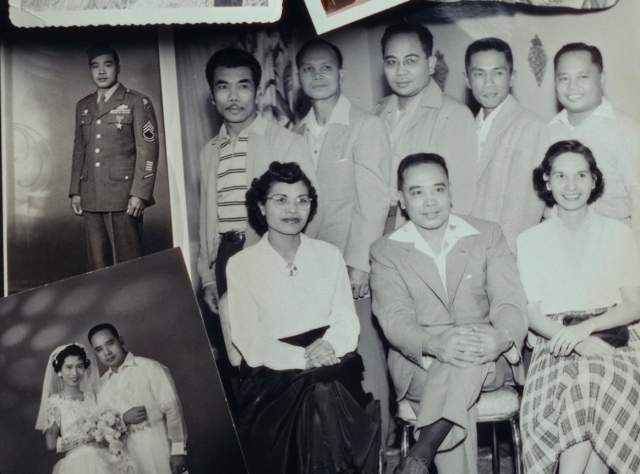
Photos Courtesy of Mana.Alaksa on Instagram, 2023.

Transformational leadership characterizes itself through ethical behavior that empowers diverse communities nationwide. It is something one would expect to innovate over time, especially within the cultural diaspora. Applying authentic leadership and a transformative nature encompasses nonprofit organizations that do not seek financial gain to achieve their goals, complete their projects, and deal with other situations. Integrating ethical leadership, morality, and authenticity can help communities grow (Bauch, 2006). When using the concept for the goals set forth, complexities become understanding to others. According to Northouse’s book on Leadership Theories (2022), “[conceptualizing] is the capacity that gives leaders the power to analyze a multitude of problems and solve them without any creative sacrifices in the process” (p. 261). Shayne Nuesca, M.S., is the subject of the following paper. A recent Syracuse University alumni, Shayne Nuesca, is a Content Strategist and one creator of the “Mana.Alaska” and “SPRHDRS” media collectives. Nuesca’s projects, such as “Mana, The History We Inherit,” are the first collection from the collective, bringing together past and present experiences of those with Filipino culture, particularly in Alaska. While Filipinos have settled in Alaska for some time, many of their stories are untold. As a natural storyteller, Nuesca found like-minded individuals to work as a team to tell stories through various mixed methods of oral stories, art, and photojournalism. This project started from the ground up in the past year and found success through communication and cultural community building. The goal was to target the Filipino diaspora in the Alaskan community and manage to reach other urban centers across the nation. It is excellent to learn from someone such as this regarding educational outreach in multiple literacy forms. Some characteristics of a leader, like Nuesca, are someone who passes down knowledge to others (Wang, 2016), including a “commitment to shared goals and being a visionary that takes the program to new heights; emotional intelligence, such as empathy and expert authority in teaching, also play a role in closing theoretical gaps in organizational practice” (Wang, 2016, p. 82). Like research skills, digital skills play one of the most vital roles in connecting to diverse audiences online in a meaningful capacity. This paper explores the topics of authenticity, ethics, and the connection to organizational culture in education. Nuesca’s framework, according to Northouse (2022), aligns with authentic leadership, involving servant, pragmatic, and theoretical approaches.

Leadership and Strategic Challenges of the Interview Situation

Much of it was on the groundwork when supplemented with digital platforms. It is clear from considering both Burns’s perspective on leadership roles and higher education perspective that ethical leadership embeds itself in the morality of a leader that impacts a follower; therefore, more work is necessary in terms of creating a leadership theory that passes down critical thinking to other incoming leaders (Northouse, 2022, p. 430; Bacon & Byfield, 2018; Burns, 1978). Due to systemic discrimination, hyper-urban and rural areas remain disconnected from other geographic locations (Carbajal, 2018). Authors found that many technological issues relate to the ability to access stable data for extended periods (Greene & Murphy, 2021). Therefore, innovators like Nuesca continue to innovate ways to bypass obstacles in front of her vision for creating a cultural community beyond borders. According to Northouse (2022), transformative and adaptive leadership align directly with diversity, equity, and inclusion, necessities within most structural systems. Although DEI is still a rapidly developing subject, it is necessary to create profound changes in a highly patriarchal and transactional culture that lacks the soft skills, compassion, and empathy to lead others through meaningful teamwork building.

“I think I got to a point where to be completely candid, I just got tired of working for people. In a way, it came to a point where it was like, what type of legacy does one want to leave behind?” Nuesca said in a virtual Zoom interview (2023). As someone whose resume includes the Alaskan state government and, most recently, an NPR news affiliate, she says that what primarily drives her is the ability to leave something behind in a “meaningful way, in a valuable way for my community” (S. Nuesca, Nov. 10, 2023). Open discourse in a particular field can make a huge difference, especially in communication. Communication is rooted in community; empathy and compassion for humanity go hand in hand with a humble, authentic leadership style. It is clear that organizational culture sets standards for behavior in employees that determine their leadership behavior; thus, a relationship between “authenticity, morality, and organizational cultures aligns accordingly” (Schein, 1985). Northouse found that authentic leadership differentiates into broader aspects of observation. One is called a pragmatic approach; the other is called a theoretic approach (2022). Nuesca kept both approaches in mind as she maneuvered a new field while using her journalism and leadership skills to create a collective free of toxic positivity.  

Assessment of Organizational and Strategic Dynamics of the Situation

Because of the fast-paced changes in almost every industry, many leaders and business owners had to pivot to continue making a positive community impact, regardless of ways of communication. What other leadership factors may be necessary to consider now for effective management? Like all the other news organizations she worked with over the past few years, that is like understanding user habits about Alaska newsreaders. There is a level of disinformation that we have to sift through. When misinformation or disinformation pops up, it spreads rapidly, and one must correct it quickly. However, it takes a lot of research, outreach, and understanding of user behaviors to be an exceptional leader. Empirical studies have shown that when educators matched servant leadership with followers who desired it, this type of leadership positively impacted performance and organizational citizenship behavior (Otero-Neira et al., 2016; Ozyilmaz & Cicek, 2015). An essential leadership and followership challenge to address is equity in accessibility. Digital literacy in leadership is far more prominent as a challenging skill rather than a soft skill. This essay aims to present a concise overview of the significant aspects of the interview on leadership conducted and to rely on critical thinking to verify the data against other research. Moral, relational transparency is all about openness to sharing one’s authentic self, actual thoughts and feelings, and internalized moral perspective (Northouse, 2022; Azanza et al., 2013). Furthermore, according to (Northouse, 2022), letting go of characteristics such as egoism, utilitarianism, and more is essential. It is imperative not to have a selfish mindset when taking on roles that pass down skills one has learned to others (Northouse, 2022, p. 427).

Specific Leadership-Focused Recommendations and Approaches

Consider the scenario below from a step-by-step management approach, such as a strategic “long-term” permanent solution versus a “resolution of immediacy.” Both servant and authentic leadership drive the influence of organizational culture. The relationship between flexible cultures and authenticity, honesty, and transparency relates to employees at an internal level that should be stimulating (Azanza, G., 2013). With the rise of new companies and their subsequent growth, it is evident that management will always be needed. Those who maintain a business find themselves in higher education first. Therefore, one should always want the right people in management, as the best leaders have the most productive followers who also turn into influential leaders. It cannot just be anybody, especially when passing lifelong knowledge to new generations. Strong managers possess significant critical thinking skills, and one of the best leadership theories to derive from is servant, authentic, and ethical leadership. Mumford’s (2000) competency criteria for a leader include skills essential for a positive workplace to sustain itself successfully.  There is more than one list of what translates to being a strong, competent leader (Mumford et al., 2000). That is why Nuesca (2023) focuses on audience engagement and community leadership as one concept. Conceptualizing in management refers to the servant leader’s thorough understanding of the organization’s purposes, complexities, and mission. “This capacity allows servant leaders to think through multifaceted problems, know if something is wrong, and address problems creatively per the organization’s overall goals” (Northouse, 2022, p. 261). Nuesca (2023) cites consistent, organic growth with remote communities in Alaska, which can have validity for other states needing digital and media literacy. Nuesca (2023) knows there is a way that you can communicate with people so that they do not feel shut down or isolated in those situations. 

“And I think the nice thing about Mana and SPRHDRS is that they are like a collective because they are a group of us. Thus, being more open to people’s ideas provides the space for that because it is a group working toward one thing. Thus, it was in a better space to kind of foster that.” Furthermore, it was unlike any time she spent as a follower in an organization. Nuesca’s success in community engagement and outreach is detailed, showcasing the strategic use of digital platforms and organic campaigns to expand the collective’s reach. Trust, interdependence, genuineness, empathy, risk, and success in leadership behavior are emphasized.

“Team-wise, it [Mana] started with three, and then we expanded to about 15. Furthermore, that is, on the content and events side of things. We had zero stories this time last year. Then we expanded that to about 30. Then, 17 made it to the museum. We had no expectations for our launch event. We thought that it would just be like us and maybe 50 people. We had 50 chairs, right? We have 50 chairs in that atrium, and 1500 people came,” Nuesca cited her first museum curation with the state as a success of servitude in leadership (2023). “So I think we could only get a sense of our reach, just like a small sense of our reach on digital. We had worked on some digital, like organic campaigns on Instagram, and Facebook and all of that” (S. Nuesca, 2023). Behavior associated with trust, interdependence, genuineness, empathy, risk, and success will lead to more beneficial and productive results. Being an effective leader requires knowing how to get things done. The collective gained unanimous support from the Filipino American National Historical Society, Alaska Chapter.

Executive Summation of Key Leadership and Related Factors

While their following on Instagram is modest, it is clear that only some things are about one’s number of followers. It takes a strong team with a strategic leader who knows what obstacles are ahead and how to solve them. For significant societal displacement impacting many communities, building a community is essential. “I think we only had 300 followers on Instagram before that weekend. And then our Facebook is laughable. The beginning was laughable. There were about 50 people who were interested in our content, but it ended up being that the word got out through the community. Also, folks are sharing our stuff without asking, so we did not account for that,” says Nuesca. Northouse (2022) allows followers to identify with something greater than they value. Followers became effective at accomplishing their jobs and fulfilling their job descriptions. “And I was adamant that we ended up on there, no matter where we were in the paper. That is another example of seeing things through and contributing to the common goal. And that was to get as many people as possible at the museum, whether 50 or 100 or 1500,” Nuesca said. “So I think supplementally, the digital stuff was just that, supplemental to our outreach. However, we used it to inform our decisions, like how we would approach folks, where we would post up, and what events we would do to promote the exhibit. So it was not like, yeah, it was not all for naught,” says Nuesca. “I had put out a press release. Two people replied, but another email went to the managing editor, and they finally listened. We sent this press release two weeks ago, but here is why the public would miss out if this does not get news coverage” (S. Nuesca, Nov. 10, 2023).

Conclusion

Servant leadership also affects the way organizational teams function. Furthermore, digital and online literacy are essential for leaders of the 21st century. Different leadership theories, such as servant leadership, require an ethical response, authenticity, transparency, and an open mind adaptable to daily challenges (Northouse, 2022). Nuesca cites word of mouth through the Filipino community and persistence that landed her collective a front page in the state newspaper. “I tend to be like a driver regarding leadership style. One needs to see things through. We [the collective] wanted it to be in the Anchorage Daily News because that is the paper of record for the state,” Nuesca said. Besides serving, Greenleaf (1970) states that a servant leader also has a social responsibility to care for the marginalized. According to Northouse (2022), transformative and adaptive leadership align directly with diversity, equity, and inclusion, which is necessary within the educational system. “We do not see ourselves as having one person in charge or one leader. So, it is a collective, which speaks to just cultural values like Filipino cultural values, as everything has to be done with a collective approach to the community goals. So that has driven us [Mana] the most,” Nuesca said. “Somebody flew up from California just to see this exhibit in the hallway in some museum in Anchorage, Alaska. This fact is a testament to just our team.” In becoming a servant leader, a leader uses less institutional power and control while shifting authority to those following the leadership (Graham, 1991).

In Mana, The History We Inherit, members of the collective share their past and current experiences with Filipino culture, particularly in Alaska. Despite Filipinos’ long presence in Alaska, many of their stories are untold. Nuesca brought together like-minded individuals to tell stories through oral stories, art, and photojournalism. Communication and community building started from scratch last year and were crucial to this project’s success. Despite their modest number of followers on Instagram, it is clear that only some things are about numbers. Inheriting stories in real-time to bring permanence to them through various art mediums is vital for Filipino communities as their elders are highly regarded for their learned knowledge over generations. In summary, servant leadership and community building interconnect in the context of cultural growth. By prioritizing service, empathy, and the development of individuals, servant leaders contribute to creating a connected web of a positive and inclusive community within an organization, fostering cultural growth and sustainability.

References

Azanza, G., Moriano, J. A., & Molero, F. (2013). Authentic leadership and organizational culture as drivers of employees’ job satisfaction. Revista De Psicología Del Trabajo y De Las Organizaciones, 29(2), 45–50. https://doi.org/10.5093/tr2013a7

Bacon, H. R., & Byfield, L. (2018). Theorizing Social Justice: Funds of Knowledge as Praxis. https://core.ac.uk/download/232775490.pdf

Bauch, P. (2006). “Reflective, Ethical, and Moral Constructs in Educational Leadership Preparation: Effects on Graduates’ Practices.” Journal of Educational Administration 44 (5): 487.

Beauchamp, T. L., & Bowie, N. E. (1988, January 1). Ethical theory and business by Tom L. Beauchamp. Open Library. https://openlibrary.org/books/OL2395733M/Ethical_theory_and_business 

Berkovich, I. (2014). “A Socio-Ecological Framework of Social Justice Leadership in Education.” Journal of Educational Administration 52 (3): 282.

Carbajal, Jose (2018). “Patriarchal Culture’s Influence on Women’s Leadership Ascendancy,” The Journal of Faith, Education, and Community: Vol. 2: Iss. 1, Article 1. Available at: https://scholarworks.sfasu.edu/jfec/vol2/iss1/1

Burns, J. M. (1978). Leadership. Harper and Row. 

Gini, A. (1997). Moral leadership: An overview – JSTOR. Moral Leadership. https://www.jstor.org/stable/25072897 

Gentry, H. (2016). A Structure for Utilizing Multicultural Principles to Strengthen the Servant Leadership Approach. https://core.ac.uk/download/235396879.pdf

Graham, J. W. (1991). Servant leadership in organizations: Inspirational and moral.

Leadership Quarterly, 2, 105-119.

Greenleaf, R. K. (1970). The servant as leader. Westfield, IN: Greenleaf Center for Servant Leadership.

Heifetz, R. (2021, June). Leadership: The Adaptive Framework – Tij Forum. TIJ FORUM. https://tijforum.org/wp-content/uploads/2021/06/Leadership-The-Adaptive-Framework.March-2021.pdf 

Ljungholm, D. (2016). Effective Servant Leadership Behavior In Organizations. Linguistic and Philosophical Investigations, 15(), 239-245.

Mumford, M. D., Zaccaro, S. J., Harding, F. D., Jacobs, T. O., & Fleishman, E. A. (2000). Leadership skills for a changing world: Solving complex social problems. The Leadership Quarterly, 11(1), 11–35. https://doi.org/10.1016/S1048-9843(99)00041-7

Northouse, P. G. (2022). Leadership: Theory and Practice (9th Edition). SAGE Publications, Inc. (US). https://reader2.yuzu.com/books/9781071834473

Otero-Neira, C., Varela-Neira, C. and Bande, B. (2016). “Supervisory servant leadership and employee’s work role performance: A multilevel mediation model,” Leadership & Organization Development Journal, Vol. 37 No. 7, pp. 860–881. https://doi-org.links.franklin.edu/10.1108/LODJ-11-2014-0230

Ozyilmaz, A., & Cicek, S. (2015). How does servant leadership affect employee attitudes, behaviors, and psychological climates in for-profit organizations? Journal of Management & Organization, 21(3), 263–290. doi:10.1017/jmo.2014.80

Reed, B., Klutts, A., & Mattingly II, T. (2019). A Systematic Review of Leadership Definitions, Competencies, and Assessment Methods in Pharmacy Education. American Journal of Pharmaceutical Education, 83(9), 7520–7532.

Schein, E. H. (1985). Organizational culture and leadership, by Edgar H. Schein. san … – JSTOR. JSTOR. Retrieved February 26, 2023, from https://www.jstor.org/stable/258322

Wang, V. C. X., Bain, B., Hope, J., & Hansman, C. (2017). Educational leadership and organizational management: Linking theories to practice. Information Age Publishing. ISBN: 9781681235134.

Kehan Xiong, Weipeng Lin, Jenny C. Li, & Lei Wang. (2016). Employee Trust in Supervisors and Affective Commitment: The Moderating Role of Authentic Leadership. Psychological Reports, 118(3), 829–848. https://doi-org.links.franklin.edu/10.1177/0033294116644370

Photo Courtesy of Getty Images

RokuTV owners might want to know about this deal ahead of Black Friday. The newest season of the RokuTV SoundBar is available to purchase before the holidays. To top it off, Roku is running more than one promo right now, meant to show that wealth is no longer a factor in truly enjoying revolutionary surround sound. 

TCL Roku TV Wireless SoundBar will be a:

  • 2.0 channel soundbar
  • Output a maximum of 120W 
  • Multiple EQ settings are available in the TV sound settings menu.
  • Wireless music streaming is available via Bluetooth

At $179.99, Roku TV users can use the code TCLROKUSOUND, dropping the price to $99.99. And that deal is still valid, according to Roku. It’s an affordable price point for the working class. There’s also a chance to win a TV plus soundbar on the Roku Blog through December 10th.

No wires mean no installation hassles. With Bluetooth and WiFi as connectors, it’s also possible to boost the sound by attaching other subwoofers. It’s straight-up expandable, making it possible to turn any room into a small theater itself. Sound is accessible, especially for Roku users.

“I mean, there was a time when having a killer home theater setup was, you know, just for someone with, maybe you know who’s really into audio and wanted everything perfect, but these days, TV’s have gotten huge, and they’re accessible. You can get a great TV for not very much,” said Anders Steele, with Roku’s Public Relations Department.

An audio expert himself, Steele feels that the target demographic of Roku has fundamentally changed as years go by.

“TV’s have gotten big and expensive, but they’ve also gotten thinned so the sound of TV’s these days isn’t what you know when the big boxes that I had when I was younger may be able to reproduce, it’s just not possible so, soundbars are a good way to to get the sound that you want. And even way better than what TV’s have been doing,” said Steele.

More specs are on the TCL website, like adding a wall-mount and compatibility with other Roku remotes. The box only comes with three components, a power cord, the soundbar, and the kit to mount it up. With simplicity on the mind of Roku leaders, TV isn’t the only home product becoming more accessible, especially during the pandemic. 

“We’ve had COVID and not a lot of people feeling comfortable going to the theater. At the same time, we have seen movies like Dune coming out simultaneously digitally. So you can create a perfect home theater experience,” said Steele.

What Roku and TCL were hoping to create was an experience of sound fit for everyone. The new SoundBar won’t become an eyesore that collects dust. It’s clutter-free, as TCL puts it. It’s easy to move. It’s portable and easy to keep out of sight. 

“Suddenly, you’re booming if you want to be. And it’s a good feeling, actually,” said Steele.

Considering how many movies are opening streaming only, it’s time to embrace the whole at-home movie experience. This trend is here for the long haul for apparent reasons. Good movies deserve even better bass.

“Streaming services are kicking, but there’s so much good stuff out there, and first-run movies are coming out and these devices, especially this one,” said Steele.

Steele pointed out that Roku’s audio teams are globally pushing the boundaries of sound and science. As far as what’s coming in 2022, Roku seeks to consistently improve its products and optimize them for the consumer experience. In short, there’s always room for improvement.

“We have people heading our acoustic designs department in Denmark. We have a separate facility there who came from like Bang and Olsen or Dynaudio, which is very high-end,” said Steele. “We have an anechoic chamber and facilities in San Jose, CA. We’re constantly working on our audio products. The price is excellent compared to competitors and compared to what’s out there for what you get.”

Considering that Black Friday is early to town this year, it’s possible to see some more great deals to complement the Roku you already have. One Twitter user tweeted that the ‘best investment I ever bought was my RokuTV bundle with the Roku SoundBar.’

Even with movie theaters opening up across the country, it’s essential to have home comfort as an alternative. A marketing campaign aimed at leaving customers with their own decisions to make is a good one. It’s true; the TCL Roku soundbar is for family and parents too.

“We’re not looking to make a killing on selling audio products. We’re trying to enable people to have a good and inspiring home theater experience. That’s our goal,” said Steele. “Being that it’s wireless, you don’t need to hire someone to help you install. You plug it in, and the automatic setup just works. It’s not an exciting answer, but the truth is, this product is for everyone.”

Taken during the 2017 Point In Time Count outside of Downtown Fullerton.

By Ashlyn Ramirez

Fullerton Mayor Bruce Whitaker tries to walk a fine line on the city’s housing crisis. He acknowledges the growing problem of homelessness but then throws up his hands and says he’s powerless to do anything about it. 

“I think it’s very important that people can find adequate living space without consuming their entire incomes,” Whitaker told the Daily Titan, the student newspaper at California State University, Fullerton. But he was quick to add in the 2017 interview that “the government itself is part of the culprit of driving prices up.” 

The city of Fullerton still accepts state and federal money to provide affordable housing. Since that 2017 interview, the city has received millions of dollars towards various ventures to clean up the streets.

Orange County also recently received $5,764,931 in federal funding for homeless assistance. It’s not clear where all of the money goes while a strained community struggles to make ends meet.

Somehow, millions of dollars turn into only 145 new units since 2017, with 45 still in construction. The New Vista Shelter consists of eight homes for transitional youth ages 18-24. Yet, Fullerton accounts for almost 1,500 unsheltered individuals alone, and Orange County as a whole saw a 43 percent rise in homelessness since then.

The problem could be even worse as the reports do not factor in people living out of their cars or “couch surfing.” In Orange County, the backdrop for the crisis is one of the nation’s wealthiest communities, a landed aristocracy served by teachers, nurses, and shopkeepers who can’t afford what passes for affordable housing in the county.

Throw in demand created by Cal State Fullerton and its working-class student body, and the magnitude of the problem starts to take shape. How made is it? The title of the American Civil Liberties Union 2019 report on Orange County — “This Place is Killing Me” — says it all.

Local government must address the humanitarian crisis presented by homelessness through permanent and affordable housing, the ACLU report concludes. 

The ACLU found the county can house their homeless but will not due to lack of political will. On top of that, the report found living conditions in affordable housing are just as bad–if not worse–than sleeping on the street. 

CSUF graduate student Christopher Rael, 33, said he was short on tuition one semester at community college during the 2008 recession. He saved money for school, and life happened. The money was gone to a cause. There was no one to fall back on. 

“For example, when I was sleeping in my car, I did have a job at the time. So that huge misconception about pulling yourself up by your bootstraps? I was doing that,” said Rael. But he was only getting 6 hours per week. And it’s hard to live off $80 weekly in any part of California, even over a decade ago.

Rael said his parents weren’t “equipped” to support an adult in college. So, he found himself sleeping in his car. Telling anyone his situation was not an option. Sometimes, you have to pay for tuition or pay for a roof over your head. 

When at a financial aid meeting to understand the metrics behind FAFSA’s Expected Family Contribution, Rael said, “I explained that I could show that I’m literally homeless. I could walk you out to my car right now, where all my stuff is in my back seat. And he [the worker] looked me square in the face, and I’ll never forget his words.”

The worker told Rael that he could lie to him [about being homeless], and it wasn’t a risk that he was willing to take. But another worker, a Havard-trained psychologist, was able to secure financial assistance for him. 

CSUF has one of the highest cases of housing and food insecurities in the state system, according to a 2018 report. Out of 23 schools, CSUF is also the least-funded public university in the entire CSU system. 

The price of living there simply does not fit the mold of a budget college experience.

In 2016, City Council-member Jennifer Fitzgerald spoke about wanting to steer CSUF away from its commuter school status. She also spoke about her efforts to end homelessness in Fullerton. “I’ve worked really hard over the last four years on ending homelessness in our community,” Fitzgerald said. 

She said she wanted to “expand affordable housing for students.” It’s been almost five years since then. It’s been ten years since Fullerton knew about their ten-year-plan to eradicate homelessness.

Fullerton does not want affordable, permanent housing or shelters near the university. Unless it’s volunteer work that they can leave when done with their good deed for the day. Why? Because the university does not fall under a designated geographic location required to have affordable housing there. 

With almost 20 percent of unsheltered individuals living out of their car in the past year, there’s no doubt there are college students who can’t afford a place or a commute.

Addressing an underrepresented community

According to a county report, the average median income for a Fullerton resident is $80,000. That’s almost 60 percent more than the average American, who makes about $47,216 a year. 

Relying on a median income to address affordable housing issues drives out locals, single families, educators, and college students alike, said Fullerton Personnel Commissioner and Climate Action Campaign Advocate Jose Trinidad Castaneda, 29.

Castaneda, a Fullerton resident and public servant is also a full-time board member of Abundant Housing in Los Angeles, an organization focused on promoting affordable housing. He monitors 17 city council meetings virtually during his current workweek. Having served as a translator for five years, Castaneda’s interest in the lack of affordable housing began out of necessity.

“My housing story began when I was looking for housing myself, and I found that nothing was affordable,” he said. So in 2018, Castaneda began organizing to get accessory dwelling units approved and drop the fees bound to them–just one way to combat the lack of affordable housing statewide.

Whitaker was not available for comment at the time of this publication. Fullerton City Councilmember Fitzgerald was also not available for comment when reached out on LinkedIn and email. Fullerton City Councilmember Jesus Silva replied with a thumbs up on LinkedIn with no further analysis.

Moving forward by acknowledging the past and present

The lack of comment years later is telling of a hidden narrative. It’s too little, too late for many to call any part of Fullerton their home unless you’re white, white-passing, or financially stable. 

“The city is segregated,” Castaneda said. “It’s economically, financially, and racially segregated.”

By 2019, ACLU SoCal found violations in the housing that Orange County offers–including abuse, harassment, neglect, and lack of cleanliness. And just like in 2016, reports existed to guide officials towards ending homelessness.

Part of the problem is policies impacting those with mental health or substance abuse issues, keeping them from the help they need. Castaneda believes that there are not enough types of housing units geared towards very low-income residents.

“I think the police and sheriff are just acting according to the councils’ will. And city councils and elected leaders have done everything to tell themselves and tell their constituents that doing anything to help solve homelessness or help people in need is only going to attract more homeless people,” said Castaneda. 

When it comes to Whitaker, Castaneda says he doesn’t even listen to him anymore. He does not find him a credible source.

No accountability remains commonplace amongst local officials.

A 2016 Fullerton Housing Authority reported that those in charge of reaching yearly goals for projects like multi-family rental housing and low-income housing loans failed to do so. Almost a million dollars went towards extremely low-income renters in only one fiscal year. 

Other years there was nothing spent at all. 

Lack of oversight happened because of the minimal amount of housing units subsidized by donors. Therefore, there’s no track of specific rent-controlled projects and the demographics of people who need them. 

Another public document found almost $100,000 spent solely on monitoring/policing expenditures and about $2,700 in relocation in the 2018-2019 fiscal year. The same year, the ACLU published their piece on Orange County’s negligent emergency shelters.

If a one-way bus ticket costs $4 for an adult, that money will send at least 675 unsheltered out of the city that maybe could not go into a shelter. 

The most common story told by residents is one of the voices falling upon deaf ears. Fullerton’s government spent money allocated for homeless assistance on one-way bus tickets before, said Castaneda. 

A beacon of ocean waves and sunny skies is where the lost get sent across counties and institutions, culminating into other pits of gentrification.

While Rael finishes his M.A., he teaches underprivileged communities in Long Beach. Over the years, he’s created school programs that give back to those on Skid Row. He believes adding sociology classes into the high school curriculum and taking police officers out of schools is a start to combating poverty’s stigmas young. 

Until the pandemic ends, though, Rael plans on staying put for the safety of his students. So, there are other ways he gives back to a community that he was a part of not long ago.

“I don’t put it on the Internet. But every day, when I walk to the coffee shop, I come out with donuts. They’re not just for me. You know what I mean; people are sleeping outside that can use breakfast. You know it’s a little bit like that that makes a major difference,” he said.

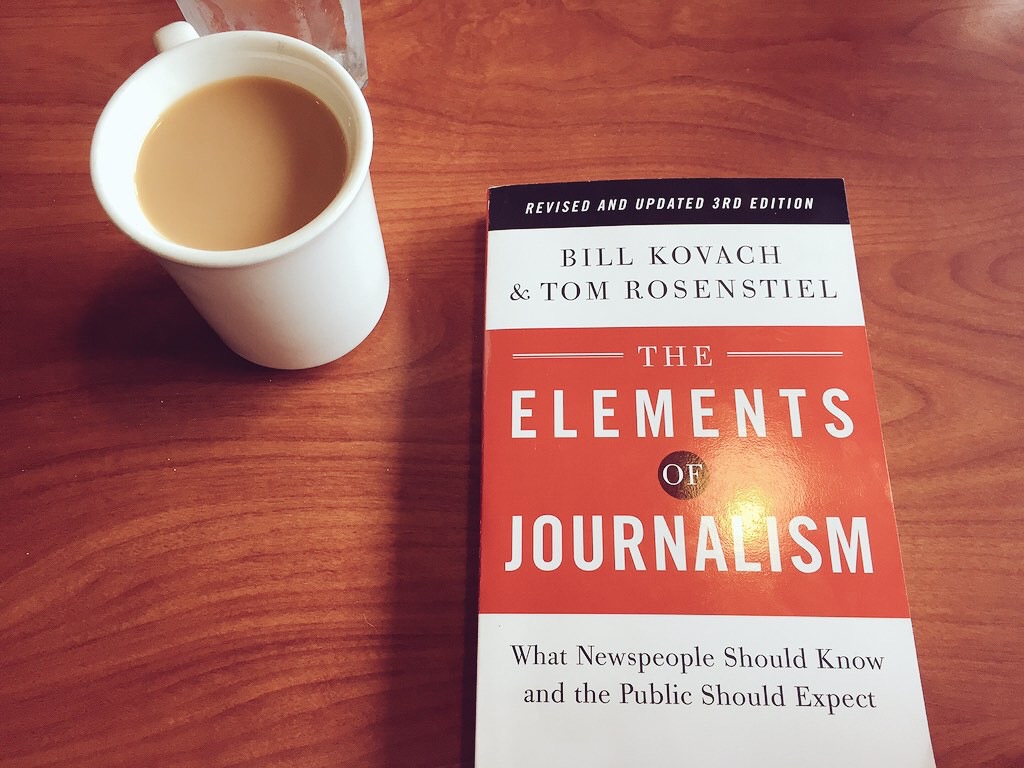
Social media is an unlikely strong asset to the elements of journalism. Photo by me | 2013

I met a small group of like-minded women that lived near San Francisco when I was maybe ten-years-old, living eight hours away. My parents didn’t particularly enjoy it, but they were like older sisters to me at the time.

We messaged through AIM chat like we were buddies that went to different schools. I can’t sit here and recall a conversation today, but I can discuss the impact it had to meet other creative people at that age.

To date, I don’t meet many other writers in my small town. When you’re a journalist, the circle gets even smaller. Therefore any support you get matters; remote support is so much more than one can think.

So here’s part of the inspiration I drew from–something that social media gave me and continues to give to so many others around the world: interactive engagement and consistent communication.

Also, thanks to Wikipedia for existing during those long nights with lonely, angry insomnia. Which actually was a little bit of asthma and sleep apnea too. But I digress.

Eventually I celebrated my 18th birthday at Bubba Gump Shrimp with my parents and two of my internet friends there. We all happen to follow each other on social media today. They do not know that I still have my gift from that day, almost a decade ago. A black, minimal yet strongly bound and empty notebook for me to write in.

That was the first push I had to follow a dream that seemed to be fading with the dying print media industry.

My internet friends and I are not close anymore but I get the comfort of knowing when I open my Instagram, I’ll see a post from up north or in South Korea. One of them got married in the past year and the pictures were breathtaking. In times like these, those thoughts are comforting.

The midpoint for a random but empowering kinship? A simple Linkin Park message board attached to the official website in 2001.

Next came designing Xangas, one of the first [and many] underground blogging platforms. And then, Myspace. I knew HTML, simple website design, blogging and photo manipulation before I left high school in 2010.

At such a young age, I never realized that I was a part of a prolific moment meant to change the way that humans interact forever. For so long, we were bound by our physical capabilities to move, to see, to feel.

Now, you can connect with someone hundreds of miles away. All of this with the touch of a button. In an era where internet bullying had just become a tangible pain [that now 59 percent of teenagers endure], I found solace from the bullying I experienced in public online.

This was unheard of at the time.

And the internet is still a very toxic place to inhabit. In fact, over three quarters of high school students two years ago did not understand the concept of media literacy, a Stanford University study found. People cannot tell between advertisements and the latter.

Since social media is mixed with all facets of communications, it’s clear that e-commerce is stepping on the toes of the press. Implementing a strong strategy to bring in various consumers through the means of education is imperative for survival.

That’s why I enjoy the career path I chose and the learning that comes with it. I am interested in how human interaction changes through the various modes of engagement over this particular modern age.

Since digital interaction is blowing up right now, it’s clear that addressing the digital divide was going to have to happen sometime. Media and digital convergence will continue to rise and the wealth gap will follow along with it.

Especially with the struggles we’re facing with COVID-19, also known as the Coronavirus. The digital divide is a staggering problem grown wildly out of control since the loss of net neutrality. COVID-19 makes it worse.

It’s clear that the use of internet and the products aligned with it [smartphones, laptops, etc.] has gone up, according to Pew Research Center and other internet study trends.

But the amount of unique consumers isn’t going up at all. Only half of the world has internet access. Why is that?

That means that our internet is designed for those who are privileged enough to afford it. That’s not right. The digital divide is real and it’s going to cause problems in an era where a pandemic changed the course of history.

Studying what these statistics mean for us is how those in the communications field can assist in helping businesses stay afloat.

I have gained a lot already from this program about what it takes to use the skills I enjoy, such as writing, and use them to better the lives of both small and big business. I hope to find out more about why social media works in the ways that it does. What does this mean for our future, especially while we are all stuck in self-isolation?

What does the rise of social media engagement reliance mean for the way we process physical emotions in reality? Can social media be a saving grace or is it wrapped up in a wealth disparity gap that we might never break down?

Whatever the case is, it’s 3 am on the west coast so I’m going to wrap this up, add in some outbound links and pictures later. This is the first thing that I’ve really finished since I started my own quarantine a month ago. It’s moments like this where I don’t feel as defeated.

I just want future generations, or even older generations to realize the good behind the internet and why we need to understand the impact of social media–mentally and culturally.

Every bit matters right now. And we’ve all got the time to read.

Even digital media nine years ago can be showcased on WordPress for those on a computer or those using a phone. Just like that, a picture can travel from a blog across the entire social media spectrum. The Brooklyn Bridge in New York City. Photography by me.

Based on your experience with WordPress, what are your impressions with working with WordPress—the pros and cons? It started as a blogging platform but has evolved—should it still be relegated for small blogs, or do you see enterprise use? Are there any blogs that you regularly follow? Pick one and critique it. Why do you like this blog? What is it about the content that makes you go back? How about the design/layout?

I learned the ins-and-outs of an almost daily student news publication during my time at Cal State Fullerton. I was on the editorial staff. Little did I know that an entire digital media spread was humanly possible to transfer from print to the web through a sole content management system.

It’s not effortless. It’s tedious. But the reach and possibilities that stem from WordPress are too immaculate to touch.

Any beginner can develop a website through this platform and become a business owner or a blogger. Or both. The management after is fairly seamless.

But friendly to everyone? Maybe not totally. That’s why there’s experts in WordPress though. We have to make money somehow.

The fact that every individual starts off with the same edit screen no matter what widgets they download makes it so that as a writer, I can easily take the skills and ideas put into another client’s website and repurpose it until my fingers fall off.

It’s like how these TikTok ferret videos of the SAME ferret keep appearing everywhere. Once it’s on the internet, it’s forever right?

Just like that, there’s a Tweet embedding into my blog post with the act of a copy-and-paste of a URL link. WordPress is teachable to a novice wanting to learn. Fixable when altering is needed. And it’s mobile-friendly with their own simple iPhone application. From blogs to media publications and even e-commerce websites, WordPress can do it all.

I feel like WordPress is the top of the list like how Adobe Premiere Pro is more well-known than Final Cut Pro. You’re paying for both the name and the goodies that come with it. This also low-key means that paying for good service prevails for a permanent revenue stream.

Even the crappiest, most mundane business can make money if they have the literacy or hire someone that harbors that capability.

With WordPress you can monetize in more than one way and expand it through sharing. But you have to know how to make all of that happen too… which is why using different tiers of paid WordPress services work for all business backgrounds.

WordPress propels small business consumerism to large markets. Think of it as like, going viral.

Downside? Those less skilled in the digital realm that lack those really good widgets are going to have some really boring pages. In the end, it’s about making minimalism pop. And WordPress captures that essence.

If you know how to work WordPress, you’ll embolden your chances of maintaining the type of clientele who doesn’t want to take the time to pick up a website and the subsequent blogging that comes along with it.

I know it’s going to sound crazy but I’m not big on following bloggers right now. I used to be huge on following artists on another platform we all know as Tumblr. It was mainly for the aesthetic and being able to talk through pictures. Sometimes, pictures being worth more than a thousand words is way better than actually having a thousand words to sift through.

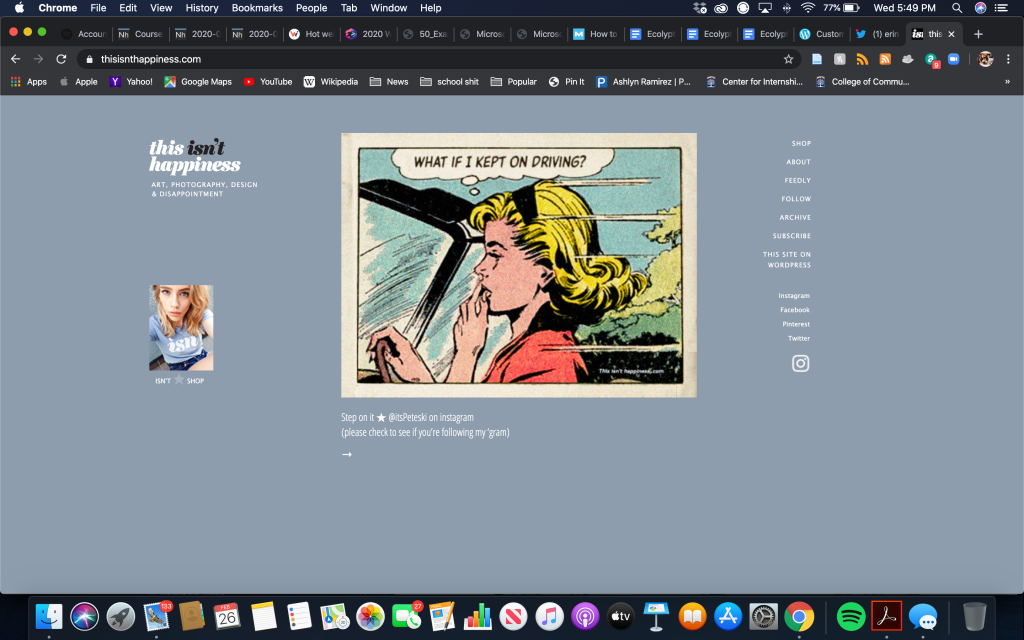
For example, look at the blogger on Tumblr known as user ‘thisisnthappiness’:

A theme is consistently followed that draws people in that focuses heavily on the visual aspect. In short it’s all about showing, not exactly telling.

Their blog is on Tumblr, has its own separate domain and is transferred to WordPress. That means the reach as an artist online is subsequently global. For example, this blogger has been around long enough to maintain these platforms and even open up an e-commerce section to make money off of instead of advertisements.

The fact that simplicity can tell a story is something that consumers vie for when consuming content online is very telling. With the options that WordPress offers to their users, it’s clear that their model is pertinent to content creation in the future.

I’ve went from print journalism to marketing, public relations, advertising and back again. For now, I’m trying to stay in the social media manager realm because it allows me to write blogs.

Meaning I get to exercise my journalistic creativity on the regular. But seriously though, I cannot express enough how underpaid and undervalued I am as a content creator. I’m marketing a brand to retain clients and often I’m still stuck cleaning a break room.

How can I continue to create an organic outreach that reaches real customers when I’m not taken seriously?

This is why I’m in school. I’m kind of hoping that with the next tier of degree in my life, I’ll get taken a little more seriously. I want to help companies grow and I’m generally not given the resources or time to make that genuine connection happen.

Unfortunately living in the metropolitan area that would see my value in Southern California is a six-figure endeavor. I’m talking like, almost a quarter of a million dollars a year just spent on living comfortably.

And I’m not at that point in my life yet. I don’t know if I’ll ever be close. It seems like my generation really got the short end of the stick and somehow it was so bad that the impact has trickled down to literally everyone except the 1 percent.

Connecting to an audience in a prolific way is something that I crave. I constantly find myself reading these feel good stories but the problem here is that they’re all bandaids for some kind of poor practice. There’s better ways to connect to an audience.

I like to do it in writing because I have social anxiety. But then that anxiety took over my words too. Being in this program has really changed me. It’s caused me to become more humble but to also see that I’m worth more than minimum wage.

Journalism is the core of the communications field. The digital convergence that happens with public relations, marketing and advertising is propelled by media convergence. I have always felt like journalists are held to a higher standard than anyone else. This is because the public trusting us is vital to democracy.

We need to strive to do better. I will never not express how important it is to keep going for the optimum outcome. I know that not everyone in the Newhouse School is there for a journalism degree. Some might hate writing entirely. But when we all work together and pay mind to the ethics behind our careers, our lives are a little bit easier.

I hope I can take the inspiration I draw from this program and really make a difference in the world through telling news via different mediums. I’ve always been a writer. A poet too. But there’s an urgency I feel regarding closing the gap that is the digital divide by exposing misinformation and promoting social awareness as our whole world inches further into the future.

I feel like I really understand why good marketing, advertising, PR and journalism will always go hand in hand with each other. One cannot function without the other in our realm.

The amount of mediums is way too many to count and hard to keep track. Right now I’m loving podcasts because it’s a really old idea with a modern twist attached to it.

Multimedia is this whole different ballgame that really gives writers new and creative ways to tell the stories that they write. If journalists like myself can’t keep up with that, we’re going to slowly lose the media literacy we’ve grown to have.

Digital convergence isn’t going to stop, so we need to hop on the bandwagon and ensure that what does come out is used to the fullest extent of the product or service’s capabilities.

Having a free press is my everything. It’s a gift unlike any other. It’s used as a curse, in some situations. I respect it above all else though, always. If more people lose their respect towards this profession, we’re going to see more open hatred across the board.

I feel like so many demographics have been looked over until recently. And this new wave of marketing towards the younger generations through the likes of big data collection is super creepy. Highly intriguing to watch change happen so quickly though.

Who would’ve known that AARPANET would turn into this massive worldwide conglomerate that corporations are fighting to control the access to? A social awakening is happening that is only going to continue to grow.

As human behavior continues to change, we’re currently seeing something unlike anything that’s been recorded by historians before. It’s not Ancient Aliens or anything, but it’s still pretty great.

The ways culture is portrayed across the world is solely because the internet is here to allow for mass sharing. I’m all here for it. Let’s keep sending memes.

It’s so hard to say what else lies in the future. I’m kind of hoping that eventually I’ll have some brain implant that’ll allow a laptop to type my thoughts for me since my carpal tunnel will probably eventually take my hands out.

Other than that, all I can do is hope that there will be some regulations that will keep customization convenient and 75 percent less invasive. Wait no, maybe like 95 percent less invasive. I’m hoping for the best.

Kind of seems like we’re living in a dystopian universe already though. At least we’re all in this together, right?

Classes like this one have taught me a handful of useful tidbits for the future. I feel like this blog has also helped me express my feelings, opinions and what not to the best of my ability. All while getting to drop facts in between.

I’ve got a glorified diary. I plan on using it as much as I can.

I have to pre-write to write.

It’s insane how all of the topics discussed over the term are things I’ve already recognized in real life but never knew the proper terminology for. I’m so excited to continue learning.

As someone who suffers from massive anxiety to the point where I can’t check my email or grades, being able to free-flow while weaving in my understanding of class topics helps me truly get the stuff that I’m reading and watching.

I guess this is essentially the tip of the iceberg with the beginning of my graduate school career. I’m over here, hand writing my last blogs for this class while thinking about my finals. Stressing. Multimedia for one and a case study for another.

The thing that I’ve truly enjoyed about this course though is the way I can now analyze and tie in the importance of digital/media convergence. I can especially see it because I recently got a new job-which at the time of typing this bit I am probably going to never go back-and I happened to be in an office setting instead of being at home.

Totally new to me. Even this program is. But I do enjoy being able to still feel like I’m in a classroom learning, instead of trying to teach something myself with very little to no direction.

So last week, all of a sudden I was staring at three computer screens. Holy second screen experience! And a keyboard and a mouse that work! I’ve been working from a broken laptop for almost a year! This is nuts!

I was able to take what I’ve learned in journalism from my undergrad and what I’ve learned about journalism innovation at my short time at Syracuse and really do a lot of work in a short amount of time. It took me 57 hours, but I got them set up with social media posts across six platforms until the end of March.

It was easily enough work to earn a grand. Turns out they thought it was worth half of that. All of this work I put into this company to make them look good and it kind of wasn’t worth the effort.

Honestly though the fact that this client thought that it was okay to pay me California minimum wage is really the result of the lack of media literacy in the country. It’s super simple to look up the average wage of a social media manager in the United States.

Add in a copy editor and marketing/personal assistant to the mix and the costs add up. I digress, though.

I’m over here incredibly upset that I’m late on my work at a super crucial time but at the same time I’m grateful that the little bit I’ve taken from this program I’ve already learned how to use to further my career path.

And I got to really experience a true multi-screen experience for a little bit that I wouldn’t have before. Even if the client was lackluster, Syracuse got me there and helped me see my worth.

There’s always people that need someone to write and edit for them. Until then I’m going to write my little heart out on this blog and hope that it provides context into myself as a person.

I’ve seen what places like Vox and the Washington Post have done for journalism. I’m writing about the Washington Post for my case study. Those are things that can be applied to basically every aspect of communications. I’m constantly intrigued with the versatile manner that journalism fits within this broad industry.

However with the way things keep changing, it’s crucial to continue to revamp and rebrand the communications industry as a whole. Especially the media, both new and old.

I can’t express enough how amazing it is to take these skills that I’ve honed over the years and use them to better something else.

Considering how my alma matter is potentially shutting down the newspaper that I gained all of these skills from as a writer, I feel like the best way I can combat the reality of a dying newspaper by furthering my knowledge in multimedia. Period.

News needs to be told. We just have to understand the obstacles that we are dealt with.

Being able to connect to consumers is the best way to continue to close the digital divide. Now we just need WiFi accessible to everyone. I hope to see that in the near future. Everyone should have the opportunity to have access to a virtual library.

Without access to simple things like blogging, student journalism and student-ran communications groups across the nation, we will never be able to dominate in the media literacy field.

I want to see a day where being a digital era journalist is considered just as important as any STEM major. I don’t think people understand how much goes into becoming an expert on a topic, hunting down verifiable sources and putting together a package that works across a multitude of platforms.

Being a watchdog is hard right now. It’s like trying to get an alcoholic to quit drinking when they just aren’t ready. But if we, as journalists, are able to gain trust and understanding, then the public might be ready to trust us later.

With the next round of presidential elections looming in the corner, I feel like finding new ways to innovate news and find news is more important than ever.