Classes like this one have taught me a handful of useful tidbits for the future. I feel like this blog has also helped me express my feelings, opinions and what not to the best of my ability. All while getting to drop facts in between.

I’ve got a glorified diary. I plan on using it as much as I can.
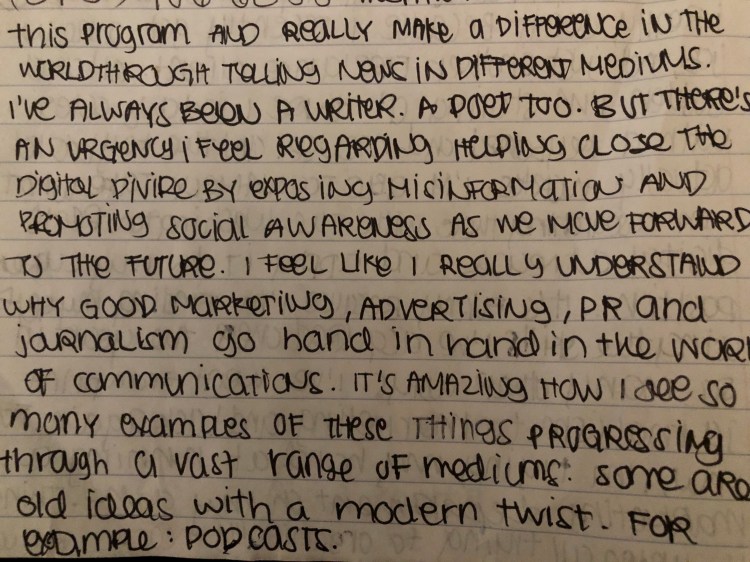
I have to pre-write to write.

It’s insane how all of the topics discussed over the term are things I’ve already recognized in real life but never knew the proper terminology for. I’m so excited to continue learning.

As someone who suffers from massive anxiety to the point where I can’t check my email or grades, being able to free-flow while weaving in my understanding of class topics helps me truly get the stuff that I’m reading and watching.

I guess this is essentially the tip of the iceberg with the beginning of my graduate school career. I’m over here, hand writing my last blogs for this class while thinking about my finals. Stressing. Multimedia for one and a case study for another.

The thing that I’ve truly enjoyed about this course though is the way I can now analyze and tie in the importance of digital/media convergence. I can especially see it because I recently got a new job-which at the time of typing this bit I am probably going to never go back-and I happened to be in an office setting instead of being at home.

Totally new to me. Even this program is. But I do enjoy being able to still feel like I’m in a classroom learning, instead of trying to teach something myself with very little to no direction.

So last week, all of a sudden I was staring at three computer screens. Holy second screen experience! And a keyboard and a mouse that work! I’ve been working from a broken laptop for almost a year! This is nuts!

I was able to take what I’ve learned in journalism from my undergrad and what I’ve learned about journalism innovation at my short time at Syracuse and really do a lot of work in a short amount of time. It took me 57 hours, but I got them set up with social media posts across six platforms until the end of March.

It was easily enough work to earn a grand. Turns out they thought it was worth half of that. All of this work I put into this company to make them look good and it kind of wasn’t worth the effort.

Honestly though the fact that this client thought that it was okay to pay me California minimum wage is really the result of the lack of media literacy in the country. It’s super simple to look up the average wage of a social media manager in the United States.

Add in a copy editor and marketing/personal assistant to the mix and the costs add up. I digress, though.

I’m over here incredibly upset that I’m late on my work at a super crucial time but at the same time I’m grateful that the little bit I’ve taken from this program I’ve already learned how to use to further my career path.

And I got to really experience a true multi-screen experience for a little bit that I wouldn’t have before. Even if the client was lackluster, Syracuse got me there and helped me see my worth.

There’s always people that need someone to write and edit for them. Until then I’m going to write my little heart out on this blog and hope that it provides context into myself as a person.

I’ve seen what places like Vox and the Washington Post have done for journalism. I’m writing about the Washington Post for my case study. Those are things that can be applied to basically every aspect of communications. I’m constantly intrigued with the versatile manner that journalism fits within this broad industry.

However with the way things keep changing, it’s crucial to continue to revamp and rebrand the communications industry as a whole. Especially the media, both new and old.

I can’t express enough how amazing it is to take these skills that I’ve honed over the years and use them to better something else.

Considering how my alma matter is potentially shutting down the newspaper that I gained all of these skills from as a writer, I feel like the best way I can combat the reality of a dying newspaper by furthering my knowledge in multimedia. Period.

News needs to be told. We just have to understand the obstacles that we are dealt with.

Being able to connect to consumers is the best way to continue to close the digital divide. Now we just need WiFi accessible to everyone. I hope to see that in the near future. Everyone should have the opportunity to have access to a virtual library.

Without access to simple things like blogging, student journalism and student-ran communications groups across the nation, we will never be able to dominate in the media literacy field.

I want to see a day where being a digital era journalist is considered just as important as any STEM major. I don’t think people understand how much goes into becoming an expert on a topic, hunting down verifiable sources and putting together a package that works across a multitude of platforms.

Being a watchdog is hard right now. It’s like trying to get an alcoholic to quit drinking when they just aren’t ready. But if we, as journalists, are able to gain trust and understanding, then the public might be ready to trust us later.

With the next round of presidential elections looming in the corner, I feel like finding new ways to innovate news and find news is more important than ever.

Photo courtesy of Wikimedia Commons.

How many times will you check your social media platforms while reading this blog?Probably a bit–I can guarantee even the most anti-social is tapped in somehow. Media convergence is prevalent right now and it’s taken a whack at the digital divide.

So about the Big Five.

Everyone has one of the Big Five of social media: Facebook, Instagram, YouTube aka Google, Twitter and LinkedIn. They all cater to vastly different parts of the internet but at this point, they’re pretty vital to any part of the communications industry.

I’m not a big fan. I grew up outside and whatever, like every other millennial. But being able to navigate through each medium is way to have success as a multimedia journalist in this age, especially when those catalysts aren’t always used for the greater good.

I mean, I’m here to tell the truth and that’s where my loyalties lie. I’m only good at words and the Big Five that came with the rise of the internet have changed the way that words are taken in.

So it’s only natural to take what I’ve learned and apply them in other places. It’s constant trial and error. It’s a challenge. It’s pretty fun and exhausting at the same time.

Why care about the Big Five?

I can’t speak for everyone in my field but I do know that we all probably learned the same exact ethics to get where we are now. I want to adhere to those ethics while still using the Big Five in a way that is beneficial to those that come across my platforms.

Presidential candidate Bernie Sanders and his campaign are pinnacles in effective ways to use social media, even when social media giants might not completely be in tune with you.

Whether it’s through social media, email or cell phone, this presidential campaign is really hitting the ground running, relying on communication to get their point across.

Fighting back against the grain?

For example, let’s look at Twitter. I’ve discussed before how Twitter’s CEO Jack Dorsey harbors a soft side for conservatives and white nationalists. Even with supposed consistent moderation and a more supposed “paid political ads” ban, Twitter is still used daily by our current President in order to push his narratives.

In short, Twitter has a huge loophole that can’t be closed.

And his Twitter following continues to grow. At 66.9 million followers as of 6 pm PST, the only president with more followers than Donald Trump is Barack Obama, with just under 111 million followers to count.

I mean, our previous POTUS was a master at communication via social media. And he still continues to be. To say his tweets are drastically different than President Trump’s is a massive understatement.

Need I post more to show the difference? I feel like there’s this clear notion of catering to a certain audience. It’s either left or right. And in-between isn’t acceptable with either side.

While Obama pushes for unity, Trump is pushing for ratings like our country is another season of the Apprentice. We all know that Rasmussen has a huge conservative-leaning bias. Where are you getting your facts from, President? Seems like you’re picking and choosing a narrative to fit your fancy. Who is really the “fake news” then?

Honesty and transparency is absolutely everything nowadays.

I wonder how many jobs will turn me down over this opinion. But it’s really all common sense to me. Use your platform right and spread awareness across the nation.

Or the world.

Even Taylor Swift got on board with that one. Here’s just a recent example of it. We all know that she finally got political last election, too.

This means that being able to innovate journalism is the only way to beat this blatant growing use of citizen journalism as propaganda that the right has really latched onto. It’s not about the rights of who is conservative and who is considered liberal. It’s about basic human rights, as well as the need for truth across the board.

Facebook is another problem. We’ve seen Mark Zuckerberg in action, trying to run around questions from Congress time and time again.

And Facebook owns Instagram. Both monopolies are being represented by the same guy, ultimately.

This guy.

All memes aside, these big tech people don’t have everyone’s best interests in mind. That’s why it’s up to those in the communications industry to harness those tools and use them for the better of society.

Our children are at risk, too.

YouTube and Google struggled with the lasting impact of alarming videos seeping into children’s videos for a few years, along with the complicit nature behind executives. If you want to read more about the YouTube kid video debacle, check out this highly extensive Medium post by James Bridle here.

To be honest, the issue highlighted in the article above is what needs to be addressed. All of these things occur because we really don’t have a clue how to keep new age propaganda from spreading.

What happened to vigilance? We’re really out here questioning scientists over climate change but not questioning those that create content to rot out our brains?

Therefore, it only makes sense to push out saturation with more mindful content. In all reality, the job trickles down to content creators.

Enter journalism. We’ve seen how the Washington Post has managed to expand their reach into far parts of the internet that many haven’t touched. And now, people in the communications industry are starting to catch on.

Maybe we can’t teach media literacy to those that are on the older spectrum. You only want to know what you seek. But the younger generations? Ready to learn and do better than us. Our lives and the way they will end up all falls on them.

This is why so many journalists are jumping on TikTok.

This is why even President Trump has a Twitch.tv channel, even if he has barely used it yet. The greatest way to garner a relationship with the public is through online transparency. And the younger we get, the more we kind of seem to care about it.

If you can’t beat them, join them. If we’re able–as multimedia journalists–to break into a new market, we’re able to not only commercialize sustained journalism, but we can spread the truth.

TikTok is full of funny videos. Twitch.tv is an Amazon affiliate meant to cater to online streaming gamers. How do you spread news through these mediums? Through letting people get a slice of life as a reporter.

It really all comes down to conversation. People want to leave their two cents in real-time. That’s why Twitter, for example, is so vital for journalists.

Live commentary and updated breaking news is an amazing and useful way to connect to whatever community you’re local to.

I use this example a lot, but living in one of California’s major fire zones means that following journalists on different platforms via social media is a way that I can stay safe. It also means that I can contribute on the ground as a freelance journalist in order to protect and inform others through something as simple as a hashtag.

At this point, hashtags are universal and make life that much more accessible.

Look at what is happening in Hong Kong right now. Riots are prevalent. Citizens are getting hurt because they want democracy. If there wasn’t such a big societal need for the Big Five, would the world be able to know about this kind of obvious government corruption?

Just because we are America doesn’t mean that we aren’t vulnerable. The facade that we are devoid of problems is highly problematic. That’s another reason why it’s imperative to keep pushing against the norm.

Facebook is not a valid news source, sorry to all the Aunts and Uncles out there that think it is. But a valid news source can use Facebook to push an even more valid narrative. On top of that, it’s a way to communicate to readers and make their experiences better with each article or livestream.

It’s going to take time and effort. And to be honest, we really don’t have a lot of time left.

With climate change, homelessness and gun control looming over our heads, on top of another presidential election, it’s clear that moves need to be made in order to gain public trust, especially for those who feel alienated in modern society. Which happens to be both sides of the political spectrum.

We have to know how to use the Big Five for the sake of everyone with internet access. It’s all about humanity and survival of the fittest. Because we aren’t going anywhere.

Once one of the Big Five falls, another will pop up to take its place. Since this particular industry is subjected to constant change, learning how to stay ahead of the game is key to staying afloat.

I’m right there with the rest of the older millennials. Technology is an enigma that I’ve been forced to master and come to terms with. I’ll always be in the learning stage with this profession, although that’s really the fun in it.

But seeing the innovations in communication is the biggest reason why the industry draws me in. Connection is everything.

Some people are homebodies, and not by choice. Some have major social anxiety, like myself, where it’s far easier to make a difference behind a computer screen. Some people have double lives to lead–I’m talking about multiple careers in order to keep a roof over their heads.

Some people want to know more than what they’ve been told. Some people just want more personalization. Some people just want to buy things they might not see in real life.

Social media helps fuel relief in all of those areas, when used correctly. Overall, it’s really a full-time job to be an expert in this field. Since the rise of the Big Five, there’s now more side hustles than ever. If you can harness that side hustle with intricate techniques, you can have a following.

And having a following not only makes money, but has a lasting impact on those that adore what you do just as much as you.