Repotting plants this morning has me thinking about the work of crafting a story. Two were propagated, and two were replanted. That means new stories were created through tiny green succulent leaves, while others started a new chapter, in a new home, rising slowly from a drastic cliffhanger.

One has root rot, so I had to take special care to cut off the dead roots without damaging the structure. It reminded me of combing through something I wrote early in the morning, and finding parts to fix. Brushing off old soil is like cleaning and tightening up the story.

When you move a plant to new soil, you’re creating a new space for growth. Roots need room to breathe, nutrients to feed on, and a rosy foundation that supports them through seasons.

Writing (and editing) is the same. A narrative might already exist. However, to truly bring impact, it often needs fresh soil. Structure, clarity, and a stronger frame to hold the weight of ideas are what usually make a story pop.

Sometimes that means trimming back; other times, it means adding in what was missing. Both require patience, strength, and resilience to grow.

Putting on makeup feels far more tedious than writing. I enjoy it. Unfortunately, I’m not especially good at it. It remains a hobby, more than a craft. Still, makeup is a lot like writing a story. It moves in chapters, with parts that blend into one another through quiet transitions.

Think about every layer of mascara like the climax of a book you can’t seem to put down or look away from. The lipliner and lipstick are the takeaway, wrapping up a story so seamlessly.

Makeup tells stories, too. Some passages are cursive, delicate, and flowing; others are written in dark ink, bold and confident. There’s a dichotomy between fountain pens and ballpoint pens, like the contrast between eyeliner and lipstick, which holds the story structure together. Then there are the bright colors behind eyeshadow—the kind that make the eyes pop like exclamation points on a page.

Blush is like an adjective, and bronzer is the adverb supporting the text with grace.

I have so much respect for the meticulous women who shape their faces as if each brushstroke were an extension of themselves. They create narratives with color and precision, crafting a beauty I can only admire from the periphery.

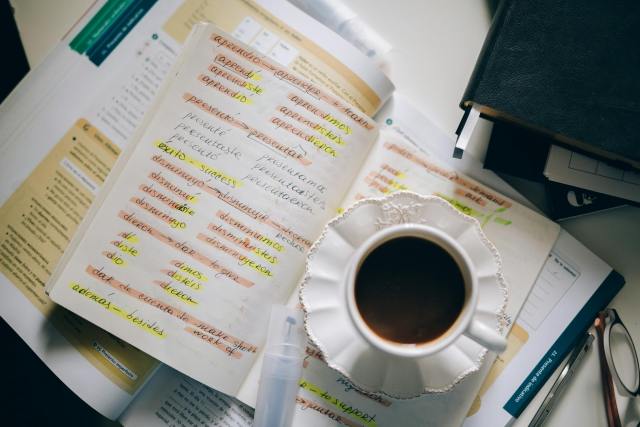
I start my mornings early, but my problems with technology begin even sooner. Sometimes, I open and close my laptop and restart it because I cannot get the internet to cooperate with me. I run to restart the router. Luckily, I get on my cellphone to finish my call to my Chair. The baby is now crying, and usually I would want to cry too. But this is something I am used to, and I’m too busy taking notes to fall apart mentally. 

I am in the final year of my dissertation, focusing on Hispanic students at Hispanic-Serving Institutions. I’m fascinated by the Digital Divide Theory and its impact on marginalized students seeking technology access, user ability (digital literacy), and their perceptions of online course success. Pursuing my doctoral degree is a distinctive milestone and an assurance to give back to my community through knowledge and awareness. That, in itself, is both my end goal and my path to happiness.

On paper, this is research. In my heart, it’s personal. 

As a first-generation Hispanic college student, first-time mother, and communications professional, I have overcome challenges in health, identity, and access. I still struggle with my health as my ulcerative colitis progresses. But I persist. 

Now, ten months postpartum, I am more motivated than ever to finish my degree, for myself and my son. I want him to see what it looks like to keep going, even when the light at the end of the tunnel is too faint to make out. I want him to grow up knowing that knowledge is indispensable, education is power, and lifting others is a part of our purpose. These are key to an inevitable path to happiness.

I took time off after my C-section to recover physically and mentally, navigating postpartum depression without the safety net of paid leave. As a self-employed communications consultant, there was no paycheck waiting for me, no HR department checking in. Recovery happened in between diaper changes, dissertation edits, and client calls.

 I’ve gone the extra mile to manage recovery, parenting, and doctoral coursework, but like many women, especially women of color, I have done it quietly while balancing family life. I do not always have childcare readily available. I have health conditions that need monitoring, like my colitis and my asthma, which result in more routine doctor appointments than most at my age. 

My son accompanies me to appointments sometimes, and he enjoys chatting on the phone when I talk to my Chair, as if he already understands the importance of what I’m working toward. He is a good sport about it, and he loves to try to grab my fountain pens and “help” me type. 

I often feel empowered knowing I can be a mom, a writer, a consultant, and a student working on a degree that is statistically difficult to achieve. I am among the 16.7 percent of Hispanic students who earn doctorates, and 2.6 percent of disabled students who earn a doctorate in education. 

I know what it’s like to feel unseen in academic spaces, as if the systems around you weren’t built with you in mind. I aim to use this research to inform institutional practices that are more inclusive, accessible, and supportive of students from all walks of life.

This process has shaped me in ways I never imagined. It has made me more empathetic, resilient, and undoubtedly sure that the work I am doing matters, not just for me or my son, but for many others who deserve to thrive in higher education.

I’ve been the student who couldn’t rely on her Wi-Fi or cell signal, but I always found a way to make things work. Some people are more disadvantaged and are unable to do the same. I’ve learned what equity means when you’re living it, not just researching it.

My career goals are founded in service. I aim to utilize my research, writing, and strategic communication skills to influence policy, guide institutions, and champion the voices of historically underrepresented groups through education. I believe deeply in the power of storytelling, not only as a former journalist but as someone who has seen how narratives can shape access to opportunity. 

This journey has not been easy, but it has been transformative. My experiences are woven into every part of who I am. It has reminded me that you can still take the next step forward even when you’re exhausted, overwhelmed, or unsure. And those steps matter. 

Those steps lead towards a seat at the table.

Sometimes I hold my breath until it hurts. And then everything in my vision is shaking. But the shake isn’t fear, per se.

There are moments of anticipation that run through your veins like ice-cold rain—moments when you take the plunge, not because it’s comfortable, but because you want the result badly enough to face the shock.

The shock burns cold, tightening my body as I submerged myself for 90 seconds. Meditate, relax, and move forward. And start the life cycle all over again.

I’ve now gone from hot water (104 degrees, to be exact) to a violent burst of refreshing cold.

The truth is, nerves are just water, and we’re all vessels. How we carry the water, how we let it flow between our fingers, determines whether it moves us forward.

So, here’s to the plunge and the shock that comes with it.

Side note: cold plunges are about 48 degrees. And I’d do it again.

Written in 2023, expanded in 2025

Being a leader in education doesn’t often come with a personal handbook. Or if it does, it’s outdated; ill-equipped for the complexities of 21st-century classrooms and communities. As we continue to confront widening disparities in educational access, especially in the wake of the COVID-19 pandemic, one truth becomes clear: effective leadership isn’t just about policies or protocols. It’s about people, and the ability to lead with empathy, community, and transformation in mind.


Leadership in the Age of Digital Learning

The pandemic redefined what it means to teach and learn. As online learning became the norm, issues like internet accessibility rose to the surface, especially in rural and low-income areas where connectivity is often limited or unreliable. But beyond technology gaps, we also saw cracks in leadership communication, especially between administrators and educators.

Outdated systems, hierarchical thinking, and transactional leadership styles have created barriers that make it difficult for teachers and students to advocate for their needs. These gaps in communication are more than logistical—they’re structural. They reflect a need for new leadership paradigms that meet today’s challenges with empathy, collaboration, and innovation.


Instructional Leadership and the 21st Century Classroom

In a 1999 study of over 800 U.S. teachers, researchers found that educators’ expectations of leadership often clashed with the realities of administration. More recently, the Journal of Organizational and Educational Leadership reaffirmed the belief that school outcomes are closely tied to leadership effectiveness. The takeaway? Instructional leadership must go hand-in-hand with technological transformation and digital literacy.

Teachers need leaders who do more than manage: they need leaders who listen, collaborate, and help create space for professional reflection and growth. These are the hallmarks of transformational leadership, as opposed to transactional leadership, which focuses more on compliance, control, and routine.


Transformational vs. Servant Leadership: A Needed Blend

According to Hu & Linden (2011), transformational leadership builds confidence and work advocacy, but it’s servant leadership—with its focus on selflessness and empathy—that enhances both satisfaction and effectiveness in teams. When combined, these leadership approaches foster a culture of trust, transparency, and empowerment across all levels of education.

As Peter G. Northouse (2021) notes, leadership rooted in empathy and community connection is essential for long-term cultural change. It empowers teachers, administrative staff, and students, particularly those from marginalized backgrounds, who go on to shape the American workforce.


Creating Lifelong Learners and Leaders

Leadership in education isn’t just about student test scores or teacher evaluations. It’s about nurturing lifelong skills like digital literacy, critical thinking, and emotional intelligence. And it’s about ensuring every stakeholder, especially those in underserved communities, has equitable access to the tools and support they need to succeed.

The literature shows a clear need for stronger communication between principals and teachers. When leaders and educators collaborate toward shared goals of inclusivity and equity, they create ripple effects that extend far beyond the classroom.


DEI and the Need for Cultural Change

Diversity, equity, and inclusion (DEI) aren’t just buzzwords. They’re essential frameworks for reshaping a system that has historically privileged transactional over transformative leadership.

Transformative, adaptive leadership aligned with DEI principles is especially urgent in a post-pandemic world where disparity gaps have widened. While DEI work remains underdeveloped in many educational settings, it offers a path forward; one grounded in soft skills, compassion, and the recognition that authentic leadership starts with human connection.


Final Thoughts

To move toward a more inclusive and effective educational system, we need more than curriculum updates or policy changes. We need leaders who understand that communication, empathy, and community are the foundations of success, not just for students, but for educators and administrators alike.

As we reevaluate the leadership values necessary for the future, one thing is clear: no relationship in education can remain purely transactional. Leadership must mean something. And it must start with listening.

In 2019, I bought my first domain. It wasn’t for my business, a brand, or even a blog that was ready for the world. I just knew I needed a space that was mine. I needed a blank slate that I could shape entirely on my own terms.

I already had a marketing portfolio. But this was different. It was a place to process, to reflect, to write what I wanted without worrying about SEO or structure—a place to yell into the void. Once upon a time, over 1,000 people followed my Tumblr for the same reason. Not a lot, but enough to feel like someone was listening. Maybe even helped by something I wrote, and I wouldn’t have known.

At the time, I was juggling freelance gigs, grad school, and the sense that I wasn’t doing enough. Not successful enough. Not published enough. Contracts were ending, my confidence was shot, and I felt like I was treading scalding hot water. But I could still build this tiny digital corner where I could show up without needing permission. Just me, my writing, and whatever I was working through.

That website has quietly housed a vast collection of writing samples, portfolio pages, late-night freewrites, and a substantial number of drafts that never saw the light of day. I was able to write through a divorce that almost derailed my career. I ultimately completed my master’s degree in Journalism Innovation during one of the most challenging periods of my life. 

Sometimes, I feel like you can hear my heart beating through the words I’ve written there. I don’t know how to do anything else but write, which, honestly, weirds people out that I feel that way. I’m not a math person. What can I say?

Sometimes my mom asks why I still pay to keep my website up. And the answer never changes: because it matters to me. Because even when I’ve felt lost, that site has been a quiet promise to keep going. A digital piece of myself, reminding me I’m still here, still writing, and still building.

And lately, the views have started stacking up again. In the past week alone, I’ve seen a 125% increase in traffic and a 179% jump in visitors.

Maybe that’s not much in the grand scheme of things.

But it’s something.

It’s mine.

Written in 2025

It’s been a while since I’ve done a free write.

So, here I am. Just sitting with my thoughts. Feeling okay. Not great, not awful. Just okay.

Lately, I’ve found myself ruminating. About everything and nothing at the same time. The paradox of politics has been especially loud in my head. We live in a moment where standing for something should matter more than ever, and yet we’re watching people fall for anything.

The divide between left and right feels enormous, but maybe we’re looking in the wrong direction. Perhaps it’s not about the dichotomy between what’s left or right. There has to be something else.

I look over at the book I’ve been reading, Pedagogy of the Oppressed by Paulo Freire. Suddenly, the thought bubble is taken over by the little speck of light you see when you’re floating to the bottom of the sea. Small, but bright.

Maybe we should be looking up and down.

Because let’s be honest: we’re not on the up and up.


The Weight We Carry

Photo by Ahsanjaya on Pexels.com

Many millennials—often burdened by debt, high rent, and economic instability—are living in multigenerational households. As of 2021, approximately 18% of millennials (ages 27–42) were living with their parents or other older relatives (Pew Research Center).

Millennials have lived through wars, pandemics, and now the normalization of fascist rhetoric in American public life. From 9/11 to Iraq and Afghanistan, to COVID-19, to the destabilizing effects of misinformation and mass surveillance, we’ve been through it. And now Gen Z is dealing with it too. And so will Gen Alpha, which is a shame.

Photo by Anna Shvets on Pexels.com

Coming together still feels like a dream. But dreams don’t happen unless we make moves. And the community needs to hit the ground running. We’re all going to have to pick up the slack.

Time does not stop for anyone.


Idiocracy, In Real Time

Photo Courtesy of The Guardian

I finally watched Idiocracy the other day. It’s satire. But barely. It’s a little scary how books and movies help us make sense of our present day.

In the U.S., most adults read at a 7th to 8th-grade level, according to the National Center for Education Statistics (NCES). Post-pandemic studies have shown a decline in literacy, particularly among young people.

This is why my son has a “banned books” shelf, for all stages of his life. I am afraid that this type of information might slip through his tiny hands if I don’t provide it. So I will. I will teach him. The most radical thing I can do, as a parent, is teach my son what the schools will not.

Knowledge is the last vestige of reality. We’re watching it slip through our phone screens. Anti-intellectualism, algorithm-driven thinking, and an overreliance on AI-generated content have reshaped how we think, what we value, and how we interact. Like Baudrillard predicted, we’ve become a nation of simulations.

We’re watching the downfall of the United States in real time.

And it’s not some abstract future. It’s now.

This is literally something that no amount of therapy, medication, or Love Island could fix, due to economic instability like this. Our stock market is inflated, and the tariffs we will and already are paying will not help.

And then there’s still half of America that doesn’t realize that. Still.


What We Need: Community, Care, and Clarity

However, there is hope.

Creator: Jae Hong | Credit: AP

Copyright: Copyright 2025 The Associated Press. All rights reserved

In California, we’ve seen mutual aid in action—from organizing during ICE operations to recovering from catastrophic wildfires. In July 2024, reports of targeted ICE activity in Los Angeles renewed the urgency around community defense, and the response was swift: neighbors supported one another. Legal aid groups mobilized. Volunteers stepped in.

We’re more than just voters. We’re protectors of the community. There may be a drastic digital divide that the wealthy abhorrently take advantage of — and people are starting to see it.

This isn’t just about left or right.

It’s about transcending fascism. About resisting late-stage capitalism. About caring for one another in a system that’s tried everything to convince us that care is a weakness. It’s about a community of care.

It’s about grassroots organizing, building community resilience, and mitigating misinformation. It’s about refusing to back down even when things feel impossible.


The population is waking up and putting their foot down. Enough is enough.

There’s still time to enact a call to action.

There’s still time to make a change.

Written in 2024 and expanded in 2025

The rise of compulsory coding in education is more than a tech trend; it’s a philosophical shift. Rooted in yes-case/no-case theory, this evolving mandate reveals deeper questions about who decides what knowledge matters, and how that knowledge shapes society.

At the heart of this analysis are two key theorists: Jean Baudrillard and Michel Foucault, whose frameworks challenge how we define “truth” in a hyper-digital age. The “yes case” reflects State-sanctioned knowledge: structured, standardized, and enforced through educational policy. The “no case,” by contrast, represents self-selected, personally valued knowledge: the kind that escapes mainstream narratives.

This study asks a fundamental question: Are we becoming more like machines, or are machines becoming more like us?

Coding as a Philosophical Shift

Kissinger (2018) explored how the rise of artificial intelligence and compulsory coding in schools introduced new “habits of mind” into public discourse. This isn’t just about tech skills, it’s about technology taking on a dominant cultural role, shaping how we think, communicate, and learn.

Baudrillard and Foucault wrote their theories long before the full impact of digital competency and AI became visible. Yet, their work, particularly Baudrillard’s ideas on digital abstraction and hyperreality, helps explain what’s happening now.

Coding for all is framed not only as a digital literacy movement but as a “transfer effect” from the digital abstractions Baudrillard warned about back in 1993 and 1995. Computational thinking, ethical dilemmas, and unintended social consequences all converge to shape a world where technology isn’t just a tool; it becomes a worldview.

Digital Shadows and Hyperreality

One striking comparison from the study is Baudrillard’s “digital Plato’s Cave.” In this metaphor, reality is no longer perceived directly, but through Digital Shadows. He asks, “Why speak, when we can communicate?” A line that underscores how interfaces and platforms mediate our human experience.

The study also connects to David Harvey’s ideas on postmodernity, pointing to a major shift in culture, politics, and economics since the 1970s. As Harvey explains, communication has become more fragmented and complex, shaped by meta-languages, meta-theories, and shifting narratives. These trends are especially visible in how different industries, including education and media, engage with coding, AI, and tech policy.

A Personal Connection

My dissertation research focuses on technology access at Hispanic-Serving Institutions, particularly for students from marginalized communities. It’s a topic informed not just by theory but by lived experience, including my time as a journalist and opinion writer.

Today, the media landscape is saturated with content; a lot of it AI-generated, rarely reviewed by humans. This shift changes not only how we communicate, but what we communicate. Trust in sources has eroded. The American perspective on global issues is often misaligned with how the rest of the world sees us. And in many cases, digital “truths” have replaced real-world understanding.

Final Thoughts

As Elon Musk warned in his own discussions about AI, digital trickery is no longer science fiction. It’s already here. I know, me quoting Elon Musk is out there, but the quote fits. Musk’s concerns mirror Baudrillard’s fears that media and machines increasingly mediate reality until the real and the artificial are indistinguishable.

As schools incorporate coding into their curricula and AI continues to evolve, we must ask: Are we equipping students with tools for empowerment, or are we embedding them even deeper into a system of abstraction?

It’s a deeply philosophical issue. It gets bigger the more the digital divide grows.

References Cited

Baudrillard, J. (1995). Simulacra and simulation. In Body, in theory: Histories of cultural materialism. University of Michigan Press.

Foucault, M. (1972). The archaeology of knowledge and the discourse on language. Translated by Alan Sheridan Smith. New York: Pantheon Books.

Foucault, M. (1981). The order of discourse. In R. Young (Ed.), Untying the text: A post-structuralist reader (pp. 48–78). Boston: Routledge & Kegan Paul.

Harvey, D. (2008). The Condition of Postmodernity. In S. Sideman & J. Alexander, The New Social Theory Reader (pp. 235–242). New York: Routledge.

Keenihan, S. (2017). Revealed today, Elon Musk’s new space vision took us from Earth to Mars, and back home again. In the conversation, Retrieved from: http://theconversation.com/revealed-today-elon-musks-new-space-vision-took-us-from-earth-to-mars-and-back-home-again-84837.

Kissinger, H. (2018). How the Enlightenment ends. Retrieved from: https://www.theatlantic.com/magazine/archive/2018/06/henry-kissinger-ai-could-mean-the-end-of-human-history/559124/

Matousek, M. (2018). Elon Musk is launching his Tesla Roadster into space to prove a point — But it’s also a brilliant marketing move. Retrieved from: https://sports.yahoo.com/elon-musk-launching-tesla-roadster-172511191.html

Schroeder, J. (2018). Toward a discursive marketplace of ideas: Reimaging the marketplace metaphor in the era of social media, fake news, and artificial intelligence. First Amendment Studies, 51(1–2), 38–60.

Rogers, C. (2018). Falcon Heavy launch leaves inspiration in its wake. Retrieved from: https://medium.com/@rogerstigers/falcon-heavy-launch-leaves-inspiration-in-its-wake-d186a1bdb8e7

Tamatea, L. (2019). Compulsory coding in education: liberal-humanism, Baudrillard and the ‘problem’ of abstraction. Research and Practice in Technology Enhanced Learning, pp. 1–29.

I admit that it hurts a little—but not entirely—to understand a Spanish meme on Twitter or Instagram. I don’t use a Spanish keyboard on my iPhone. And try talking to other fluent Spanish speakers with Google Translate. I can’t compete.

In short, I probably understand about 30 percent of what’s said to me, and that’s being generous. I religiously use subtitles when watching Narcos: Mexico. To say it’s just embarrassing is an understatement. Finding a solution to my first-world problem ended up with long-term plans for the future.

Straddling Two Worlds with One Language

It’s awkward being multiracial but monolingual. I’m the less than half of US-born Hispanics whose Spanish is forever subpar. I’m also part of the less than half of 1.4 million Filipinos surveyed in 2013 that live in California and do not speak Tagalog, Visayan, or Ilocano.

Pew Research Center data shows that over 60 percent of Hispanic-born citizens in the United States speak Spanish. And U.S. Census Bureau projections found that the share of those who speak only English at home rose from 26 percent in 2013 to 34 percent in 2020.

But 95 percent of all Latino adults see the value in learning how to read and write in Spanish.

So Where Do We Fit In?

So, where does the third of non-Spanish but Hispanic-identifying speakers fit in? There are 10 million Americans that identify as multiracial. What cultures do they identify with best?

My sense of culture is chaotic. Probably not by choice. None of my tattoos match. I feel more like a “Valley Girl” than anything. A language barrier is always an excuse for staying mute on the matter. Growing up in rural Southern California, I never realized just how much I would be missing out by never picking up either of my native languages.

Language Lost, Identity Fractured

I have a handful of Spanish-English dictionaries that we’ve barely touched. At 29, I’m too old to pick up a second language thoroughly. Eighteen is the cut-off for learning a new language well, according to Scientific American. When faced with the debacle of my monolingualism in public, I usually smile and say that I can’t roll my tongue for an “r.”

Therefore, I’m not going to try.

Trust me, learning Spanish in high school pales compared to someone who has spoken Spanglish their entire life. I yearn to code-switch and never will.

I lack an identity except being a third-generation American, which is less than impressive these days.

The Cultural Disconnect Is Real

Being light-skinned yet part of a multitude of beautiful yet underrepresented groups made for an interesting upbringing. It shows a stark difference between first-generation immigrants and the latter.

People who speak Tagalog or Spanish—primarily Spanish—will come up to me to strike up a conversation. In Costco, at the DMV, whatever. The blank stare they get in response that turns into a nervous laugh is always met with an eyeful of disappointment when realizing that I’m entirely white-washed.

“Why didn’t your parents teach you any other languages?” — the general question I feel — masked behind a blank stare with a hint of disdain. The ability to speak the Ilocano dialect was never something my maternal grandmother taught to anyone. My great-grandparents took the language with them when they passed. My mom never knew her father, a Hispanic and native military man who died before birth.

My paternal grandmother and my older family on her side speak Spanish, while the younger generations know very little. I could never understand why until I got older.

A Legacy of Survival

People seemingly tend to look down on others who share their heritage but lack the native language. Statista found that 7.3 million Americans in multiracial relationships identify as Hispanic. But you have to consider the term itself is a colloquial monolith.

I didn’t choose only to speak English. Colonialism did that for me. Not every person gets a chance to hold onto the cultures that represent their identity. All I can continue to do is look on with envy at those that can migrate their entire conversation to a different language like nothing. And I can also advocate for change.

My entire racial identity, my whole family, gentrified themselves over a century to assimilate and survive. The part left the Philippines for Hawaii before World War II. The rest fled Sonora, Mexico, and settled in the most significant Yaqui indigenous settlement in all of Arizona.

With some long-winded, extensive research, I’ve realized that both my mom and dad’s parents felt it was better to keep all aspects of culture at home and exude as much whiteness as possible. I developed a sense of fractured yet eloquent cultures through other avenues: vast amounts of literature, food, music, and art.

Rewriting the Future

I hope to instill those values in my future children—while allowing them to learn more than what English has to offer. While I may never really know where my indigenous roots lie because colonialism took those languages from my generation, I don’t plan on leaving my family to figure out their identities on their own.

Thirty years ago, there wasn’t a push to have bilingual children like there is now. Interracial marriage is still a relatively new concept. It was a survival tactic for survival in a nation ruled by white, wealthy men. When I look into U.S. census records, I don’t see a sole family name there. The fact that immigrants had to swallow their cultures to fit into America’s bubble is egregious.

Written in 2017

In 2003, Ian Urbina, a graduate student at the University of Chicago, abandoned his doctoral dissertation after completing a small journalism internship with an investigative reporter, which gave him a taste of reporting.

That taste landed him a job at one of the largest news media outlets in the US, a handful of awards, and a few investigative pieces that were turned into feature films.

That’s where his love of journalism has culminated over the past 14 years. 

A Fulbright scholar who worked and lived in Havana for three years, he was enrolled in a dual degree program with majors in cultural anthropology and history. He received a degree in history from Georgetown University in 1995. 

Urbina wasn’t expecting to find himself with the platform he has as a writer. Things just happened that way. He says his life gets weirder the deeper you go.

“I’m kind of an oddball, and so my day-to-day is pretty different than the norm,” he said.

Urbina’s typical day as an investigative journalist consists of long hours. Currently on book leave, he sDCs his days at home near The New York Times’ Washington, D.C., Bureau. 

He wakes up at the crack of dawn, around 4 in the morning, because that’s when he feels he works better. He has one main editor he works with in DC.

Urbina has his own office conveniently in the backyard. 

“I am a bit distractible, and do much better in kind of a deprivation chamber,” he said.

Urbina credits luck for his position at the Times. Little by little, he worked his way up the totem pole through freelancing. A stint with Think Tank is the moment that changed Urbina’s life, thrusting him into a mainstream career as a journalist. He learned everything there is to know about journalism “on the fly” at the DC Bureau metro desk, because he was clueless.

“I knew how to string together a sentence and make it occasionally somewhat polished, but I didn’t really know newspaper writing and all that entails,” he said.

After a year and a half at the metro desk, Urbina moved on to bureau chief. He managed an area from Kentucky to Ohio, noting that it was a challenging job because it was not a local paper — this was a paper on a national scale.

One day, Urbina asked his editor if he could take a break from the news rat race and spend a year researching documents for an article.

His editor said Go for it.

Urbina’s most recent piece, “Outlaw Ocean,” was not only his longest stint at three years, but it was also a dangerous and stressful assignment. It’s currently being turned into a book and a movie project. 

His editor was not a fan of the series, which also added to the list of obstacles surrounding the completion of his research.

Investigating overseas requires taking several precautions, including ensuring that you have a reliable translator. Without one, a journalist is entirely out of luck. No matter how good a writer you are, without a translator, nothing will be done properly, Urbina says.

Violence was a common occurrence while reporting in other countries.

The things he saw included murder on camera, sex trafficking, slavery, and arms trafficking.

Urbina says that spacing out trips, along with knowing who you hire, helps with the investigative process abroad.

“The difficulty (with reporting overseas) is the reporting itself,” he said.”You’re chasing really bleak stuff.”

His findings on fracking in 2011, in a series called “Drilling Down,” helped show the US how dangerous the government’s want for natural gas really was. Before Democrats were against the practice, fracking was seen as a gold mine, while few questioned whether it was detrimental to the government. Urbina, however, questioned it.

“That series was tough, it was aggressive, and we got really strong pushback from the (oil) industry,” he said.

Urbina felt that the documents surrounding the fracking piece were some of the craziest things he had read as an investigative journalist.

“So like, everyone knew there was radioactivity in the waste coming out of these wells,” he said. “But no one knew how much radioactivity.”

The fracking, which caused drastic leaks that seeped into sewage treatment plants, was utterly unknown to the nation until it was investigated.

 It took hours of poring over documents and piecing together each part of the puzzle little by little, but in the end, it worked out for him. That’s one of the key things to being a journalist–sifting through documents.

“If you can name the monster, you can beat the monster, and that’s true with document hunting,” he said.

Urbina had a team compile an extensive archive of the documents found, still accessible on the Times today. There have been no corrections made to the database, which contains approximately 500 pages of documents.

“Drilling Down” took at least four months to report, Urbina says. As far as requesting documents through the Freedom of Information Act (FOIA), Urbina typically expects a response within at least a year. 

A beat, data, documents, and spreadsheets are the tools for any journalist’s future. It’s also essential to consider distribution afterward. A reporter’s job is to break news, not follow it. 

What is key to investigative reporting is finding a new way to tell old stories, or new stories. 

That’s the space that Urbina lives in.

“You’re not done when you finish the story,” he said. “Don’t just put it in your paper.”