The U.S. economy added just 33,000 jobs in July 2025, according to the Bureau of Labor Statistics. That’s a drastic drop from June’s revised total of 194,000 jobs. For context, economists expected around 175,000 new jobs. We fell significantly short.
July’s report signals a broader slowdown in job growth. While one month doesn’t define a trend, many professionals are understandably anxious. When growth slows, layoffs often follow. Freelancers feel the squeeze. Recent grads face fewer opportunities. Hiring freezes kick in.
So what can we do in times like these?
Servant Leadership Is More Important Than Ever
In tough economic times, good leadership matters more. But not the traditional top-down kind. Now is the time for servant leadership.
Servant leaders put people first. They provide support, empathy, and stability. They coach, uplift, and guide without ego. They ask, How can I help?
And they recognize that hope is a strategic advantage.
If you’re in a position of leadership right now, consider how you can create clarity and calm for your team, your peers, or even your online community. Compassion-driven leadership is needed in this very moment.
Learn Instead of Just Earn: Why Literacy Is the Key
When jobs are scarce, learning becomes survival. But we’re not just talking about college degrees. In today’s world, we need multiple forms of literacy:
Digital literacy — How systems work, how content flows, how to use platforms like LinkedIn and Indeed
Media literacy — Understanding how information is framed and shared online
Platform literacy — How to navigate job boards, remote hiring, and gig platforms
The goal? Know how everything works. Learn how the systems move so you can move through them, and around them if necessary.
If You’re Out of Work: What to Focus On
1. Keep updating your portfolio. Even if you’re not currently employed, you can keep working on projects, freelance tasks, writing samples, or mock case studies. Employers want to see momentum and proof that you’re still growing. Consider a writing challenge for your blog (like what I’m doing right now) or create a collection of social media posts that drive engagement for a marketing or SEO role.
2. Stay open to freelance or contract work. Many employers are cutting full-time roles but still need help. Contract gigs can fill in financial gaps and keep your skills sharp. Yes, freelancing means buying your own health insurance. But it also means flexibility and survival. Right now, survival matters.
3. Don’t underestimate your effort. You’re not alone. Many talented people are in the same position. For example, one job I applied to a couple of weeks ago had 954 job applicants. Another one had over 1600. The U.S. has over 330 million people, and only 33,000 new jobs were added. That’s not on me or you.
4. Keep working on that small business. Staying busy is best, and while staying busy does not always mean being profitable, it does mean that there is a way to contribute to your community. And in turn, the community will support you. For those who sell goods, consider farmers’ markets. Get chronically online. Open that Etsy or Shopify. Interact with others online and watch how organic engagement draws people in.
5. Have empathy for yourself. It’s okay to be tired. It’s okay to feel stuck or stagnant. Sometimes, you find yourself meditating, but you might wonder why you’re being still when you need to be working. It’s okay. Just don’t confuse stillness with failure, because we aren’t failures. We are surviving. And if you’re trying, you’re doing more than enough.
If You Have a Job: Hold It Carefully, But Strategically
If you’re currently employed, be mindful of how you contribute. Help others where you can. Be someone who uplifts. But also: keep your options open. Update your resume, refresh your skills, and quietly prepare for what’s to come, which will probably include further drastic economic instability.
So, here I am. Just sitting with my thoughts. Feeling okay. Not great, not awful. Just okay.
Lately, I’ve found myself ruminating. About everything and nothing at the same time. The paradox of politics has been especially loud in my head. We live in a moment where standing for something should matter more than ever, and yet we’re watching people fall for anything.
The divide between left and right feels enormous, but maybe we’re looking in the wrong direction. Perhaps it’s not about the dichotomy between what’s left or right. There has to be something else.
I look over at the book I’ve been reading, Pedagogy of the Oppressed by Paulo Freire. Suddenly, the thought bubble is taken over by the little speck of light you see when you’re floating to the bottom of the sea. Small, but bright.
Maybe we should be looking up and down.
Because let’s be honest: we’re not on the up and up.
Many millennials—often burdened by debt, high rent, and economic instability—are living in multigenerational households. As of 2021, approximately 18% of millennials (ages 27–42) were living with their parents or other older relatives (Pew Research Center).
Millennials have lived through wars, pandemics, and now the normalization of fascist rhetoric in American public life. From 9/11 to Iraq and Afghanistan, to COVID-19, to the destabilizing effects of misinformation and mass surveillance, we’ve been through it. And now Gen Z is dealing with it too. And so will Gen Alpha, which is a shame.
Coming together still feels like a dream. But dreams don’t happen unless we make moves. And the community needs to hit the ground running. We’re all going to have to pick up the slack.
Time does not stop for anyone.
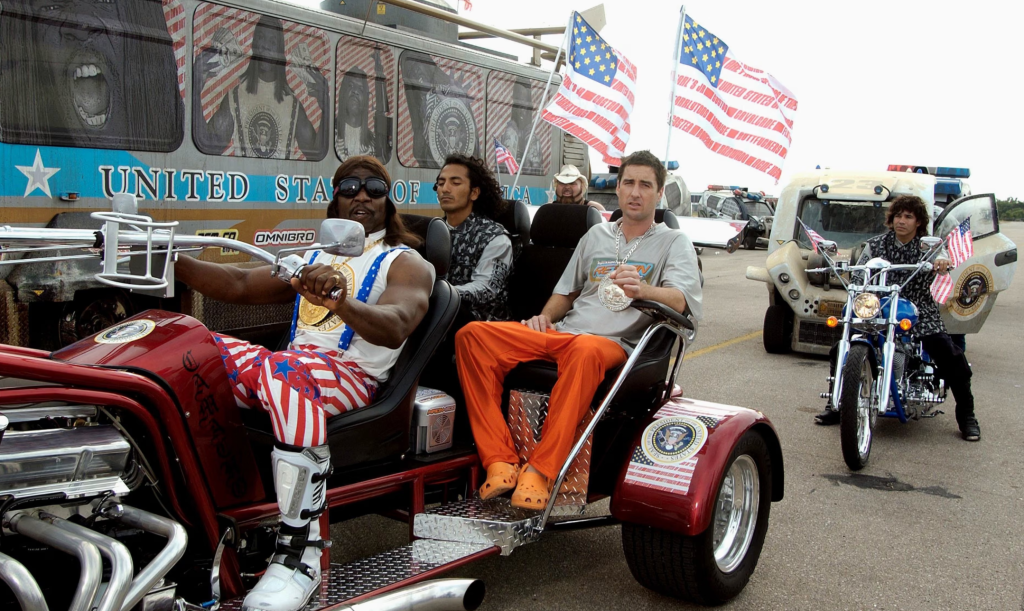
Idiocracy, In Real Time
Photo Courtesy of The Guardian
I finally watched Idiocracy the other day. It’s satire. But barely. It’s a little scary how books and movies help us make sense of our present day.
In the U.S., most adults read at a 7th to 8th-grade level, according to the National Center for Education Statistics (NCES). Post-pandemic studies have shown a decline in literacy, particularly among young people.
This is why my son has a “banned books” shelf, for all stages of his life. I am afraid that this type of information might slip through his tiny hands if I don’t provide it. So I will. I will teach him. The most radical thing I can do, as a parent, is teach my son what the schools will not.
Knowledge is the last vestige of reality. We’re watching it slip through our phone screens. Anti-intellectualism, algorithm-driven thinking, and an overreliance on AI-generated content have reshaped how we think, what we value, and how we interact. Like Baudrillard predicted, we’ve become a nation of simulations.
We’re watching the downfall of the United States in real time.
And then there’s still half of America that doesn’t realize that. Still.
What We Need: Community, Care, and Clarity
However, there is hope.
Creator: Jae Hong | Credit: AP
Copyright: Copyright 2025 The Associated Press. All rights reserved
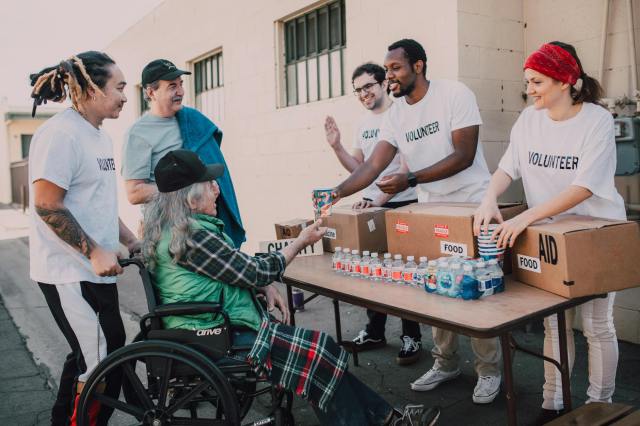
In California, we’ve seen mutual aid in action—from organizing during ICE operations to recovering from catastrophic wildfires. In July 2024, reports of targeted ICE activity in Los Angeles renewed the urgency around community defense, and the response was swift: neighbors supported one another. Legal aid groups mobilized. Volunteers stepped in.
We’re more than just voters. We’re protectors of the community. There may be a drastic digital divide that the wealthy abhorrently take advantage of — and people are starting to see it.
This isn’t just about left or right.
It’s about transcending fascism. About resisting late-stage capitalism. About caring for one another in a system that’s tried everything to convince us that care is a weakness. It’s about a community of care.
It’s about grassroots organizing, building community resilience, and mitigating misinformation. It’s about refusing to back down even when things feel impossible.
The population is waking up and putting their foot down. Enough is enough.
Print Capitalism, National Consciousness, and the Problem with Imagined Unity
Benedict Anderson’s Imagined Communities: Reflections on the Origin and Spread of Nationalism explores how nationalism itself is not an organic development, but a socially constructed phenomenon—an “imagined community” built through shared language, culture, and crucially, the rise of print capitalism.
It’s a fascinating idea: that nations are not bound by physical borders but rather by the stories we tell ourselves and each other. Citizens build a sense of belonging through newspapers, novels, and other printed materials, one that gives people the illusion of unity with others they would never meet in person. Anderson argues that this shared sense of identity, while powerful, is imagined. And like many imagined ideas, it can be wielded for both cohesion and control.
From Anderson’s perspective, the press plays a key role in this construction. Journalism becomes not just a source of information, but a vehicle for reinforcing nationalism. At its best, the media is supposed to serve as a societal watchdog. However, under capitalism, and particularly when a handful of billionaires control the press, those ideals are often replaced by narratives that serve power, not the people.
In the same way state-run media has shaped public perception in countries like North Korea, Vietnam, or China (as Anderson notes on pages 282–283), Western media, though less overtly controlled, often operates in similar ways. Ownership, agenda, and ideology filter what gets published, and who gets heard. The result? A narrative that normalizes colonization, glorifies the past, and renders oppression and exploitation invisible to the mainstream.
And even though much of the media we consume today is digital rather than printed, the impact remains. Words are still “printed” on screens, and they still construct a national identity; one that often leans heavily into conservative values, especially in the U.S., where Christianity and nationalism frequently go hand in hand.
Now, to be clear: having pride in your country isn’t inherently problematic. However, when a selective history and curated information shape national pride, things become murky. For example, in certain rural or conservative parts of the U.S., public school curricula are shaped by school boards that may actively omit or distort historical realities, glossing over colonization, slavery, and the actual mechanics of war. Omission doesn’t just limit education; it undermines the national consciousness that Anderson described. Without honest reflection, the “imagined community” becomes more myth than memory.
Capitalism and the Narrative of Truth
Ideologies such as Marxism and socialism were founded on principles of equity and solidarity. However, when capitalism becomes the dominant force behind the circulation of information—especially when profit and power are involved—those ideals can be easily co-opted. Greed alters the public narrative, and we see this play out in real time through today’s media coverage.
A Case Study in Media Framing
Take, for example, the ongoing starvation of Palestinian infants and children. A leaked internal memo from The New York Times in 2024 reportedly instructed journalists not to refer to Palestine as an “occupied territory” or to use terms like “genocide” in their reporting. Regardless of where one stands politically, it’s clear that such editorial decisions shape public perception. When specific terms are off-limits, it becomes harder for readers to access the full scope of the issue, and easier for a particular narrative to dominate the conversation. In this case, media objectivity is compromised in favor of language that supports nationalist or colonialist perspectives.
It’s not just about one conflict and its framing. It’s about how newsrooms, under the pressure of corporate and political interests, contribute to constructing national identity in ways that may exclude or silence others. They become complicit. When journalism becomes selective in its truth-telling, it undermines its purpose and reinforces a worldview that favors power over people.
The Tech-Nationalism Feedback Loop
Nationalism, as Anderson reminds us, is a modern invention. It evolves alongside technology, and as our means of communication become faster and more centralized, so too does the spread of nationalist ideology. We see this not just in the U.S., but in places like China, where digital firewalls and media censorship shape the public’s perception of national identity. There, access to platforms like Facebook or Instagram is restricted not only for security, but also to protect a specific narrative.
Secular Allegiance and the Flattening of Identity
Anderson also notes how nationalism can take on secular forms, replacing religious or ethnic affiliations with allegiance to the nation-state. In theory, this could be a unifying force; something that helps people move beyond divisions and find common ground. In practice, though, it often flattens identity, pushing marginalized communities to conform to dominant norms or risk exclusion.
Conclusion: Who Gets Left Out?
This tension between imagined unity and lived reality is perhaps the most pressing issue with nationalism today. When media and technology become tools of influence rather than inquiry, they no longer create bridges between people. They create barriers.
Anderson’s work doesn’t just help explain the origins of nationalism; it offers a lens for questioning the stories we’re told and the systems that tell them. It invites us to ask the following question: Who benefits from these imagined communities? Who gets left out of the story?
Exploring the Impact of Technology Access on the Educational Success of Disabled Latino Students in Community Colleges
May 10, 2024
ABSTRACT
Southern California’s Hispanic and Latino population is among the most highly enrolled in college institutions, partially due to their involvement in Hispanic-serving duties (Tagami & Reagan, 2022). However, graduating, especially when a disability is involved, is not often discussed (Tagami & Reagan, 2022). This conference proposal addresses the exceptional progress in educational disparity experienced by disabled Latino students in community colleges, with a primary focus on the profound impact of digital media. Incorporating theoretical insights from critical scholars such as Jean Baudrillard, Laurence Tamatea, Michel Foucault, Tom Shakespeare, and David Harvey, this research examines the delicate balance of access to technology, disability, ethnicity, and academic outcomes within the framework of community colleges in the contemporary postmodern era. The disabled community benefits from online educational communities through videos, language, and discussion (Narciso Jr., 2023). This study aims to explore how disabled Latino students navigate the digitally mediated educational environment, drawing on Baudrillard’s analysis of hyperreality and Harvey’s examination of globalization. Simulated environments and global reciprocity influence this era, which remains characterized by images. Understanding the benefits of this demographic in utilizing and accessing technology is crucial.
The research question of this study concerns how digital media in the classroom positively impacts the educational success of Latino students with disabilities in community colleges. Some ways include flexible classwork, online educational digital media, and finding community through discussion boards and online classes (Narciso Jr., 2023). This pivotal research question on the ubiquity of digital media seeks to explore the intersectionality of technology access, disability, ethnicity, and higher education outcomes within the context of community colleges. As researchers delve further into artificial intelligence, it is more crucial than ever to investigate the ongoing impact of technology on educational success. The research question aims to explore how access to technology can facilitate remarkable educational success for disabled Latino students, particularly in the postmodern era characterized by hyperreality, simulations, and the proliferation of digital media. By examining the impact of digital media on an online community of education, one can see the benefits for community college students. The frameworks of Jean Baudrillard’s hyperreality and David Harvey’s globalization provide a comprehensive understanding of the implications of these phenomena on the educational experiences of disabled Latino students.
There are strategies and interventions that community colleges can implement to bridge the digital divide and significantly enhance the educational success of Latino students with disabilities within the context of postmodern social, economic, and technological dynamics. If effectively implemented, these strategies can offer a brighter future for these students and improve their educational outcomes. This study will employ a qualitative methodology, focusing on small cluster groups to interview students about how online coursework has changed their perception of schooling since the advent of online education. The study could include an end-of-year survey, in addition to interviews, to understand how the online course benefited the students. Other methods include mixed methods, utilizing an instrument to understand the GPA of students who enroll in online classes, primarily using digital media to teach their students.
The digital divide uniquely manifests among disabled Latino students in community colleges. They harbor specific upsides in accessing and utilizing technology for educational purposes. Jean Baudrillard’s theories of simulacra and simulations apply to the digital experiences of disabled Latino students, influencing their engagement with academic content and digital media. Hyperreality and hyperrealism refer to Baudrillard’s concept of living in a technological simulation, unlike nature (Baudrillard, 1994). With so much hyperreality and hyperrealism existing in our modern world, it is clear that there is a crisis of representation where traditional forms of knowledge, authority, and truth remain in question, and that crisis manifests itself according to Harvey in various domains, such as art, literature, and politics (2008). However, through the crisis, there is a light at the end of the tunnel. An analysis of interviews will reveal the conditions of postmodernity, as described by David Harvey (2008), that influence the educational experiences and opportunities available to disabled Latino students in community colleges, particularly in terms of globalization, consumerism, and cultural fragmentation. Community colleges bypass the problems of postmodernity and utilize them to their advantage, pushing forward certificate completion and two-year degree programs at the student’s pace (Tagami & Reagan, 2022; Narciso Jr., 2023).
There are two theoretical concepts that Baudrillard and Foucault have based on social truths, representing state-sanctioned knowledge and individually, self-selected valued knowledge (Foucault, 1972, 1981; Baudrillard, 1994). Some studies raise one fundamental question, such as Tamatea’s compulsory coding and education (2019). The question to consider in this study is whether we are becoming more like machines or machines are becoming more like humans. With the rise of artificial intelligence and technological advances in education and the media, Baudrillard wrote that the vast influence of digital competency was tangible (1994). However, the study aims to challenge the downsides Baudrillard felt were probable in his analysis of simulacra. Tamatea’s ‘yes theory’ points towards technological success in early schooling through coding, a way of simulation by machine (2019). Community college success remains significant to specific theories that consider this framework. The research question and its subsequent sub-genres aim to make a unique contribution to the broader discourse on educational equity, access to technology, and social justice. By drawing insights from Baudrillard and Harvey, we aim to comprehend the complexities of contemporary digital media proliferation, particularly in the form of online communities, highlighting the urgency of the issue and the necessity for ongoing action. Furthermore, it aims to highlight the strategies and interventions employed by these institutions to continue bridging the digital divide and promoting educational equity.
Introduction
This research paper aims to shed light on the composite directions at play, contributing to the discourse on inclusive education, informing policy and practice to foster digital inclusivity, and gathering data on educational outcomes for disabled Latino students in community colleges. There is an intricate web of individual and environmental factors in the lives of disabled people, along with marginalized groups. When one adds more of a marginalized community to that fact, it becomes so much more of a topic to discuss, and social models for disabilities are often separate (Shakespeare, 2010). Minorities’ issues cannot undergo naivety, however. It creates a slightly different topic because it is a universal experience shared by all humanity. The world as it is currently known is defined by what Jean Baudrillard calls “Simulacra and Simulation.” While Baudrillard considered hyperrealism a detriment to society and globalization, there are strengths in digital educational communities (1994). The way education looks today is shaped by technology, moving beyond technological convergence and addressing the digital divide. Unfortunately, marginalized communities will be the most affected by this digital divide and will likely find the most success in technological use as a result. Simulacra is especially important in combating the digital divide and promoting educational success among community college students. Understanding how the digital community helps students is one of the main questions to ask during a qualitative study.
Literature Review
The proposed qualitative study challenges the concepts of meaning and truth, making it clear that individuals must possess the literacy necessary to see through traditional notions of meaning and truth. In a world dominated by simulacra, meaning becomes arbitrary, and truth becomes relative. However, communities can come together to determine what is accurate, truthful, and not. David Harvey’s “Condition of Postmodernity” focuses on cultural fragmentation and how traditional structures and identities are stabilized (2008). Cultural fragmentation refers to the combination of multiple cultures rather than maintaining many separate versions, which often occurs in digital communities. Various aspects of society are reflected through culture, economics, and politics, indicating instability and fluidity behind identities and their meanings, which is further exacerbated by the proliferation of media, consumer culture, and globalization. Hispanic and Latino students in many counties across California make up most enrolled students completing their academic careers (Tagami & Regan, 2022). However, many do that part-time through a community college (Johnson, 2016). When researchers add the disabled community, it becomes apparent that this is even harder to achieve, especially when disabled people are not a community that defines itself through culture, gender, or race. Theoretically, individuals in college or community college may have a different viewpoint and success rates due to the use of hyperrealism and its impact on the conditions of postmodernity’s cultural fragmentation and globalization. In Baudrillard’s “Simulacra and Simulation,” it is clear that there are four orders of simulation, defined by hyperreality. The death of the real and simulacra serves as a control mechanism, contributing to the critique of postmodern society (1994).
Theoretical Framework and Methodology
According to Tom Shakespeare, people with disabilities come from an oppressed viewpoint. A social model is proof of that, and it is logically impossible for a qualitative researcher to find disabled people who are not facing oppression, meaning that all marginalized communities have the disabled community within them, meaning that they are within and without accommodations universally because all disabilities are different (Shakespeare, 2010). Therefore, while a college can cater to the Hispanic community, they are not going to necessarily cater to the disabled community, creating a world that has a lack of free space. Only “barrier-free enclaves are possible,” which community college creates through the ease of digital courses. Researchers indicate that most accommodations occur at the community college level (Narciso Jr., 2023). This universal experience of humanity is shaped by the role of globalization in postmodernity. As Harvey argues, capitalism and its endless expansion and accumulation drive spatial and temporal restructuring processes that underpin the postmodern condition (2008). The restructuring process is evident through the expansion of the World Wide Web and the ability to connect with others who are not physically nearby. When one ties this in with Baudrillard’s concepts and framework behind hyperreality, it becomes clear that the significance of urbanization and the built environment helps individuals understand postmodernity and how there are focal points for the concentration of capital, culture, and power (Harvey, 2008; Baudrillard, 1995). How we view those things through digital media is significant for qualitative discussion. Capital culture and power find themselves through the digital connection of others and the sharing of capital experiences.
Conclusion
Therefore, the emergence and development of AI have accelerated the Age of Reason through the digital community. With the rise of online courses, educational digital media, including video content, online meetings, and discussions, are beneficial for student success at the community college level. As the work is decades old, being able to relate simulacra (simulation) to digital abstraction was an unintended beneficial consequence for individuals and society (Baudrillard, 1994). Digitalization’s existential status unknowingly brought educational ubiquity to the table. Ultimately, hyperrealism influences what people see and know, as well as how nature is perceived versus what the media wants us to see. However, it also creates an even digital playing field, where students can be part of a community while living their personal lives outside of school. Students should be able to distinguish between what it means to be digitally literate and what it does not. Baudrillard relates to David Harvey’s study of the “Condition of Postmodernity” because Harvey states there has been a change in cultural and political-economic practices since 1972 (Harvey, 2008; Baudrillard, 1994).
Furthermore, there are differences in communication, as well as the complexity and nuances of the industries of interest and the cultures. Consider a digital Plato‘s Cave, where reality is discernible through a digital shadow; therefore, Baudrillard notes, “Why speak when we can communicate” (1995). Their place in the simulacra brought them in contact with modernist theories and narratives. The success of community college students remains enhanced through communication technology.
References
Baudrillard, J. (1994). Simulacra and Simulation. Ann Arbor. University of Michigan Press.
Baudrillard, J. (1995). Simulacra and simulation. In Body, in theory: Histories of cultural materialism. University of Michigan Press.
Foucault, M. (1972). The archaeology of knowledge and the discourse on language. Translated by Alan Sheridan Smith. New York: Pantheon Books.
Foucault, M. (1981). The order of discourse. In R. Young (Ed.), Untying the text: A post-structuralist reader (pp. 48–78). Boston: Routledge & Kegan Paul.
Harvey, D. (2008). The Condition of Postmodernity. In S. Sidema, & J. Alexander, The New Social Theory Reader (pp. 235–242). New York: Routledge.
Shakespeare, T. (2010). “The Social Model of Disability.” The Disability Studies Reader. Ed. Lennard J. Davis. New York: Routledge. 266–73. Print. (Pre-print copy.)
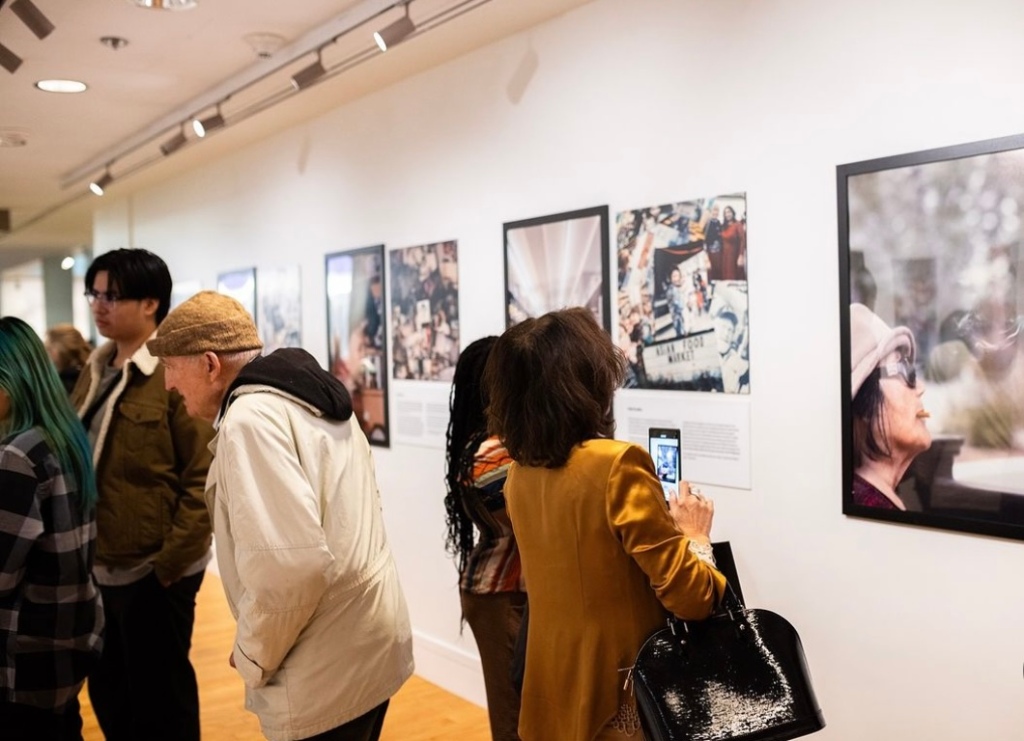
Photos Courtesy of Mana.Alaksa on Instagram, 2023.
Transformational leadership characterizes itself through ethical behavior that empowers diverse communities nationwide. It is something one would expect to innovate over time, especially within the cultural diaspora. Applying authentic leadership and a transformative nature encompasses nonprofit organizations that do not seek financial gain to achieve their goals, complete their projects, and deal with other situations. Integrating ethical leadership, morality, and authenticity can help communities grow (Bauch, 2006). When using the concept for the goals set forth, complexities become understanding to others. According to Northouse’s book on Leadership Theories (2022), “[conceptualizing] is the capacity that gives leaders the power to analyze a multitude of problems and solve them without any creative sacrifices in the process” (p. 261). Shayne Nuesca, M.S., is the subject of the following paper. A recent Syracuse University alumni, Shayne Nuesca, is a Content Strategist and one creator of the “Mana.Alaska” and “SPRHDRS” media collectives. Nuesca’s projects, such as “Mana, The History We Inherit,” are the first collection from the collective, bringing together past and present experiences of those with Filipino culture, particularly in Alaska. While Filipinos have settled in Alaska for some time, many of their stories are untold. As a natural storyteller, Nuesca found like-minded individuals to work as a team to tell stories through various mixed methods of oral stories, art, and photojournalism. This project started from the ground up in the past year and found success through communication and cultural community building. The goal was to target the Filipino diaspora in the Alaskan community and manage to reach other urban centers across the nation. It is excellent to learn from someone such as this regarding educational outreach in multiple literacy forms. Some characteristics of a leader, like Nuesca, are someone who passes down knowledge to others (Wang, 2016), including a “commitment to shared goals and being a visionary that takes the program to new heights; emotional intelligence, such as empathy and expert authority in teaching, also play a role in closing theoretical gaps in organizational practice” (Wang, 2016, p. 82). Like research skills, digital skills play one of the most vital roles in connecting to diverse audiences online in a meaningful capacity. This paper explores the topics of authenticity, ethics, and the connection to organizational culture in education. Nuesca’s framework, according to Northouse (2022), aligns with authentic leadership, involving servant, pragmatic, and theoretical approaches.
Leadership and Strategic Challenges of the Interview Situation
Much of it was on the groundwork when supplemented with digital platforms. It is clear from considering both Burns’s perspective on leadership roles and higher education perspective that ethical leadership embeds itself in the morality of a leader that impacts a follower; therefore, more work is necessary in terms of creating a leadership theory that passes down critical thinking to other incoming leaders (Northouse, 2022, p. 430; Bacon & Byfield, 2018; Burns, 1978). Due to systemic discrimination, hyper-urban and rural areas remain disconnected from other geographic locations (Carbajal, 2018). Authors found that many technological issues relate to the ability to access stable data for extended periods (Greene & Murphy, 2021). Therefore, innovators like Nuesca continue to innovate ways to bypass obstacles in front of her vision for creating a cultural community beyond borders. According to Northouse (2022), transformative and adaptive leadership align directly with diversity, equity, and inclusion, necessities within most structural systems. Although DEI is still a rapidly developing subject, it is necessary to create profound changes in a highly patriarchal and transactional culture that lacks the soft skills, compassion, and empathy to lead others through meaningful teamwork building.
“I think I got to a point where to be completely candid, I just got tired of working for people. In a way, it came to a point where it was like, what type of legacy does one want to leave behind?” Nuesca said in a virtual Zoom interview (2023). As someone whose resume includes the Alaskan state government and, most recently, an NPR news affiliate, she says that what primarily drives her is the ability to leave something behind in a “meaningful way, in a valuable way for my community” (S. Nuesca, Nov. 10, 2023). Open discourse in a particular field can make a huge difference, especially in communication. Communication is rooted in community; empathy and compassion for humanity go hand in hand with a humble, authentic leadership style. It is clear that organizational culture sets standards for behavior in employees that determine their leadership behavior; thus, a relationship between “authenticity, morality, and organizational cultures aligns accordingly” (Schein, 1985). Northouse found that authentic leadership differentiates into broader aspects of observation. One is called a pragmatic approach; the other is called a theoretic approach (2022). Nuesca kept both approaches in mind as she maneuvered a new field while using her journalism and leadership skills to create a collective free of toxic positivity.
Assessment of Organizational and Strategic Dynamics of the Situation
Because of the fast-paced changes in almost every industry, many leaders and business owners had to pivot to continue making a positive community impact, regardless of ways of communication. What other leadership factors may be necessary to consider now for effective management? Like all the other news organizations she worked with over the past few years, that is like understanding user habits about Alaska newsreaders. There is a level of disinformation that we have to sift through. When misinformation or disinformation pops up, it spreads rapidly, and one must correct it quickly. However, it takes a lot of research, outreach, and understanding of user behaviors to be an exceptional leader. Empirical studies have shown that when educators matched servant leadership with followers who desired it, this type of leadership positively impacted performance and organizational citizenship behavior (Otero-Neira et al., 2016; Ozyilmaz & Cicek, 2015). An essential leadership and followership challenge to address is equity in accessibility. Digital literacy in leadership is far more prominent as a challenging skill rather than a soft skill. This essay aims to present a concise overview of the significant aspects of the interview on leadership conducted and to rely on critical thinking to verify the data against other research. Moral, relational transparency is all about openness to sharing one’s authentic self, actual thoughts and feelings, and internalized moral perspective (Northouse, 2022; Azanza et al., 2013). Furthermore, according to (Northouse, 2022), letting go of characteristics such as egoism, utilitarianism, and more is essential. It is imperative not to have a selfish mindset when taking on roles that pass down skills one has learned to others (Northouse, 2022, p. 427).
Specific Leadership-Focused Recommendations and Approaches
Consider the scenario below from a step-by-step management approach, such as a strategic “long-term” permanent solution versus a “resolution of immediacy.” Both servant and authentic leadership drive the influence of organizational culture. The relationship between flexible cultures and authenticity, honesty, and transparency relates to employees at an internal level that should be stimulating (Azanza, G., 2013). With the rise of new companies and their subsequent growth, it is evident that management will always be needed. Those who maintain a business find themselves in higher education first. Therefore, one should always want the right people in management, as the best leaders have the most productive followers who also turn into influential leaders. It cannot just be anybody, especially when passing lifelong knowledge to new generations. Strong managers possess significant critical thinking skills, and one of the best leadership theories to derive from is servant, authentic, and ethical leadership. Mumford’s (2000) competency criteria for a leader include skills essential for a positive workplace to sustain itself successfully. There is more than one list of what translates to being a strong, competent leader (Mumford et al., 2000). That is why Nuesca (2023) focuses on audience engagement and community leadership as one concept. Conceptualizing in management refers to the servant leader’s thorough understanding of the organization’s purposes, complexities, and mission. “This capacity allows servant leaders to think through multifaceted problems, know if something is wrong, and address problems creatively per the organization’s overall goals” (Northouse, 2022, p. 261). Nuesca (2023) cites consistent, organic growth with remote communities in Alaska, which can have validity for other states needing digital and media literacy. Nuesca (2023) knows there is a way that you can communicate with people so that they do not feel shut down or isolated in those situations.
“And I think the nice thing about Mana and SPRHDRS is that they are like a collective because they are a group of us. Thus, being more open to people’s ideas provides the space for that because it is a group working toward one thing. Thus, it was in a better space to kind of foster that.” Furthermore, it was unlike any time she spent as a follower in an organization. Nuesca’s success in community engagement and outreach is detailed, showcasing the strategic use of digital platforms and organic campaigns to expand the collective’s reach. Trust, interdependence, genuineness, empathy, risk, and success in leadership behavior are emphasized.
“Team-wise, it [Mana] started with three, and then we expanded to about 15. Furthermore, that is, on the content and events side of things. We had zero stories this time last year. Then we expanded that to about 30. Then, 17 made it to the museum. We had no expectations for our launch event. We thought that it would just be like us and maybe 50 people. We had 50 chairs, right? We have 50 chairs in that atrium, and 1500 people came,” Nuesca cited her first museum curation with the state as a success of servitude in leadership (2023). “So I think we could only get a sense of our reach, just like a small sense of our reach on digital. We had worked on some digital, like organic campaigns on Instagram, and Facebook and all of that” (S. Nuesca, 2023). Behavior associated with trust, interdependence, genuineness, empathy, risk, and success will lead to more beneficial and productive results. Being an effective leader requires knowing how to get things done. The collective gained unanimous support from the Filipino American National Historical Society, Alaska Chapter.
Executive Summation of Key Leadership and Related Factors
While their following on Instagram is modest, it is clear that only some things are about one’s number of followers. It takes a strong team with a strategic leader who knows what obstacles are ahead and how to solve them. For significant societal displacement impacting many communities, building a community is essential. “I think we only had 300 followers on Instagram before that weekend. And then our Facebook is laughable. The beginning was laughable. There were about 50 people who were interested in our content, but it ended up being that the word got out through the community. Also, folks are sharing our stuff without asking, so we did not account for that,” says Nuesca. Northouse (2022) allows followers to identify with something greater than they value. Followers became effective at accomplishing their jobs and fulfilling their job descriptions. “And I was adamant that we ended up on there, no matter where we were in the paper. That is another example of seeing things through and contributing to the common goal. And that was to get as many people as possible at the museum, whether 50 or 100 or 1500,” Nuesca said. “So I think supplementally, the digital stuff was just that, supplemental to our outreach. However, we used it to inform our decisions, like how we would approach folks, where we would post up, and what events we would do to promote the exhibit. So it was not like, yeah, it was not all for naught,” says Nuesca. “I had put out a press release. Two people replied, but another email went to the managing editor, and they finally listened. We sent this press release two weeks ago, but here is why the public would miss out if this does not get news coverage” (S. Nuesca, Nov. 10, 2023).
Conclusion
Servant leadership also affects the way organizational teams function. Furthermore, digital and online literacy are essential for leaders of the 21st century. Different leadership theories, such as servant leadership, require an ethical response, authenticity, transparency, and an open mind adaptable to daily challenges (Northouse, 2022). Nuesca cites word of mouth through the Filipino community and persistence that landed her collective a front page in the state newspaper. “I tend to be like a driver regarding leadership style. One needs to see things through. We [the collective] wanted it to be in the Anchorage Daily News because that is the paper of record for the state,” Nuesca said. Besides serving, Greenleaf (1970) states that a servant leader also has a social responsibility to care for the marginalized. According to Northouse (2022), transformative and adaptive leadership align directly with diversity, equity, and inclusion, which is necessary within the educational system. “We do not see ourselves as having one person in charge or one leader. So, it is a collective, which speaks to just cultural values like Filipino cultural values, as everything has to be done with a collective approach to the community goals. So that has driven us [Mana] the most,” Nuesca said. “Somebody flew up from California just to see this exhibit in the hallway in some museum in Anchorage, Alaska. This fact is a testament to just our team.” In becoming a servant leader, a leader uses less institutional power and control while shifting authority to those following the leadership (Graham, 1991).
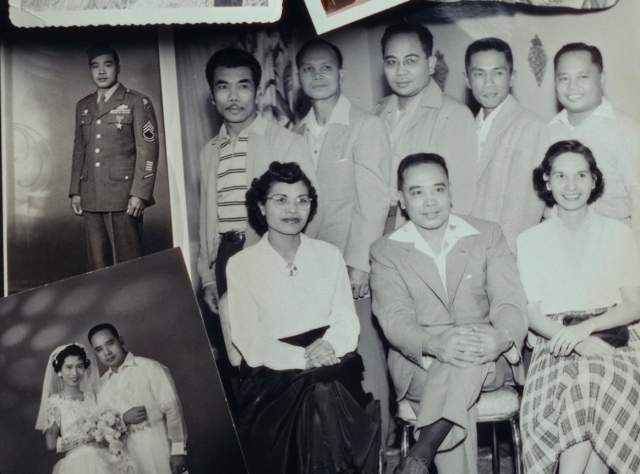
In Mana, The History We Inherit, members of the collective share their past and current experiences with Filipino culture, particularly in Alaska. Despite Filipinos’ long presence in Alaska, many of their stories are untold. Nuesca brought together like-minded individuals to tell stories through oral stories, art, and photojournalism. Communication and community building started from scratch last year and were crucial to this project’s success. Despite their modest number of followers on Instagram, it is clear that only some things are about numbers. Inheriting stories in real-time to bring permanence to them through various art mediums is vital for Filipino communities as their elders are highly regarded for their learned knowledge over generations. In summary, servant leadership and community building interconnect in the context of cultural growth. By prioritizing service, empathy, and the development of individuals, servant leaders contribute to creating a connected web of a positive and inclusive community within an organization, fostering cultural growth and sustainability.
References
Azanza, G., Moriano, J. A., & Molero, F. (2013). Authentic leadership and organizational culture as drivers of employees’ job satisfaction. Revista De Psicología Del Trabajo y De Las Organizaciones, 29(2), 45–50.https://doi.org/10.5093/tr2013a7
Bauch, P. (2006). “Reflective, Ethical, and Moral Constructs in Educational Leadership Preparation: Effects on Graduates’ Practices.” Journal of Educational Administration 44 (5): 487.
Berkovich, I. (2014). “A Socio-Ecological Framework of Social Justice Leadership in Education.” Journal of Educational Administration 52 (3): 282.
Carbajal, Jose (2018). “Patriarchal Culture’s Influence on Women’s Leadership Ascendancy,” The Journal of Faith, Education, and Community: Vol. 2: Iss. 1, Article 1. Available at: https://scholarworks.sfasu.edu/jfec/vol2/iss1/1
Ljungholm, D. (2016). Effective Servant Leadership Behavior In Organizations. Linguistic and Philosophical Investigations, 15(), 239-245.
Mumford, M. D., Zaccaro, S. J., Harding, F. D., Jacobs, T. O., & Fleishman, E. A. (2000). Leadership skills for a changing world: Solving complex social problems. The Leadership Quarterly, 11(1), 11–35.https://doi.org/10.1016/S1048-9843(99)00041-7
Otero-Neira, C., Varela-Neira, C. and Bande, B. (2016). “Supervisory servant leadership and employee’s work role performance: A multilevel mediation model,” Leadership & Organization Development Journal, Vol. 37 No. 7, pp. 860–881. https://doi-org.links.franklin.edu/10.1108/LODJ-11-2014-0230
Ozyilmaz, A., & Cicek, S. (2015). How does servant leadership affect employee attitudes, behaviors, and psychological climates in for-profit organizations? Journal of Management & Organization, 21(3), 263–290. doi:10.1017/jmo.2014.80
Reed, B., Klutts, A., & Mattingly II, T. (2019). A Systematic Review of Leadership Definitions, Competencies, and Assessment Methods in Pharmacy Education. American Journal of Pharmaceutical Education, 83(9), 7520–7532.
Schein, E. H. (1985). Organizational culture and leadership, by Edgar H. Schein. san … – JSTOR. JSTOR. Retrieved February 26, 2023, from https://www.jstor.org/stable/258322
Wang, V. C. X., Bain, B., Hope, J., & Hansman, C. (2017). Educational leadership and organizational management: Linking theories to practice. Information Age Publishing. ISBN: 9781681235134.
Kehan Xiong, Weipeng Lin, Jenny C. Li, & Lei Wang. (2016). Employee Trust in Supervisors and Affective Commitment: The Moderating Role of Authentic Leadership. Psychological Reports, 118(3), 829–848. https://doi-org.links.franklin.edu/10.1177/0033294116644370
Say bye to the problematic personalized news feature.
For the average consumer, it will be considered a win for privacy. Today, the company silently turned off their “Personal News” feature on their Google Assistant.
The end of another Google AI-based program impacts the Android community and Google product users at home. While a standard news feature remains on the Google Nest Mini (6:30 on a Friday), there’s no reasoning behind why it’s gone, according to a report from The Verge. As far as consumers go, many are left to wonder what’s next for the tech giant.
Google’s met their fair share of concern over privacy–or lack thereof–regarding their AI projects. On top of security concerns, there’s also the concern about not controlling your news feed. There’s the concern of fake news hitting the airwaves.
And through it all, top media organizations continue to create short headlines for Google. Some outlets abandoned the route entirely–while engagement through audio remains the oldest living mode of communication.
Forty-one percent of Americans are listening to regular podcasts, a study with Pew Research Center found. Another 83 percent of the public listens to traditional radio.
An algorithm isn’t currently capable of producing audio-rich news for a large audience demographic. Since the need for audio production is still growing in the digital sector, maybe Google will introduce something new.
We are finally saying goodbye to a nosy, algorithmic news option that has operated since 2019. Soon, another algorithm will take its place. The goal? To better serve their audience.
Social media is an unlikely strong asset to the elements of journalism. Photo by me | 2013
I met a small group of like-minded women that lived near San Francisco when I was maybe ten-years-old, living eight hours away. My parents didn’t particularly enjoy it, but they were like older sisters to me at the time.
We messaged through AIM chat like we were buddies that went to different schools. I can’t sit here and recall a conversation today, but I can discuss the impact it had to meet other creative people at that age.
To date, I don’t meet many other writers in my small town. When you’re a journalist, the circle gets even smaller. Therefore any support you get matters; remote support is so much more than one can think.
So here’s part of the inspiration I drew from–something that social media gave me and continues to give to so many others around the world: interactive engagement and consistent communication.
Also, thanks to Wikipedia for existing during those long nights with lonely, angry insomnia. Which actually was a little bit of asthma and sleep apnea too. But I digress.
Eventually I celebrated my 18th birthday at Bubba Gump Shrimp with my parents and two of my internet friends there. We all happen to follow each other on social media today. They do not know that I still have my gift from that day, almost a decade ago. A black, minimal yet strongly bound and empty notebook for me to write in.
That was the first push I had to follow a dream that seemed to be fading with the dying print media industry.
My internet friends and I are not close anymore but I get the comfort of knowing when I open my Instagram, I’ll see a post from up north or in South Korea. One of them got married in the past year and the pictures were breathtaking. In times like these, those thoughts are comforting.
The midpoint for a random but empowering kinship? A simple Linkin Park message board attached to the official website in 2001.
Next came designing Xangas, one of the first [and many] underground blogging platforms. And then, Myspace. I knew HTML, simple website design, blogging and photo manipulation before I left high school in 2010.
At such a young age, I never realized that I was a part of a prolific moment meant to change the way that humans interact forever. For so long, we were bound by our physical capabilities to move, to see, to feel.
Now, you can connect with someone hundreds of miles away. All of this with the touch of a button. In an era where internet bullying had just become a tangible pain [that now 59 percent of teenagers endure], I found solace from the bullying I experienced in public online.
This was unheard of at the time.
And the internet is still a very toxic place to inhabit. In fact, over three quarters of high school students two years ago did not understand the concept of media literacy, a Stanford University study found. People cannot tell between advertisements and the latter.
Since social media is mixed with all facets of communications, it’s clear that e-commerce is stepping on the toes of the press. Implementing a strong strategy to bring in various consumers through the means of education is imperative for survival.
That’s why I enjoy the career path I chose and the learning that comes with it. I am interested in how human interaction changes through the various modes of engagement over this particular modern age.
Since digital interaction is blowing up right now, it’s clear that addressing the digital divide was going to have to happen sometime. Media and digital convergence will continue to rise and the wealth gap will follow along with it.
Especially with the struggles we’re facing with COVID-19, also known as the Coronavirus. The digital divide is a staggering problem grown wildly out of control since the loss of net neutrality. COVID-19 makes it worse.
It’s clear that the use of internet and the products aligned with it [smartphones, laptops, etc.] has gone up, according to Pew Research Center and other internet study trends.
But the amount of unique consumers isn’t going up at all. Only half of the world has internet access. Why is that?
That means that our internet is designed for those who are privileged enough to afford it. That’s not right. The digital divide is real and it’s going to cause problems in an era where a pandemic changed the course of history.
Studying what these statistics mean for us is how those in the communications field can assist in helping businesses stay afloat.
I have gained a lot already from this program about what it takes to use the skills I enjoy, such as writing, and use them to better the lives of both small and big business. I hope to find out more about why social media works in the ways that it does. What does this mean for our future, especially while we are all stuck in self-isolation?
What does the rise of social media engagement reliance mean for the way we process physical emotions in reality? Can social media be a saving grace or is it wrapped up in a wealth disparity gap that we might never break down?
Whatever the case is, it’s 3 am on the west coast so I’m going to wrap this up, add in some outbound links and pictures later. This is the first thing that I’ve really finished since I started my own quarantine a month ago. It’s moments like this where I don’t feel as defeated.
I just want future generations, or even older generations to realize the good behind the internet and why we need to understand the impact of social media–mentally and culturally.
Every bit matters right now. And we’ve all got the time to read.
Even digital media nine years ago can be showcased on WordPress for those on a computer or those using a phone. Just like that, a picture can travel from a blog across the entire social media spectrum. The Brooklyn Bridge in New York City. Photography by me.
Based on your experience with WordPress, what are your impressions with working with WordPress—the pros and cons? It started as a blogging platform but has evolved—should it still be relegated for small blogs, or do you see enterprise use? Are there any blogs that you regularly follow? Pick one and critique it. Why do you like this blog? What is it about the content that makes you go back? How about the design/layout?
I learned the ins-and-outs of an almost daily student news publication during my time at Cal State Fullerton. I was on the editorial staff. Little did I know that an entire digital media spread was humanly possible to transfer from print to the web through a sole content management system.
It’s not effortless. It’s tedious. But the reach and possibilities that stem from WordPress are too immaculate to touch.
Any beginner can develop a website through this platform and become a business owner or a blogger. Or both. The management after is fairly seamless.
But friendly to everyone? Maybe not totally. That’s why there’s experts in WordPress though. We have to make money somehow.
The fact that every individual starts off with the same edit screen no matter what widgets they download makes it so that as a writer, I can easily take the skills and ideas put into another client’s website and repurpose it until my fingers fall off.
It’s like how these TikTok ferret videos of the SAME ferret keep appearing everywhere. Once it’s on the internet, it’s forever right?
Just like that, there’s a Tweet embedding into my blog post with the act of a copy-and-paste of a URL link. WordPress is teachable to a novice wanting to learn. Fixable when altering is needed. And it’s mobile-friendly with their own simple iPhone application. From blogs to media publications and even e-commerce websites, WordPress can do it all.
I feel like WordPress is the top of the list like how Adobe Premiere Pro is more well-known than Final Cut Pro. You’re paying for both the name and the goodies that come with it. This also low-key means that paying for good service prevails for a permanent revenue stream.
Even the crappiest, most mundane business can make money if they have the literacy or hire someone that harbors that capability.
With WordPress you can monetize in more than one way and expand it through sharing. But you have to know how to make all of that happen too… which is why using different tiers of paid WordPress services work for all business backgrounds.
WordPress propels small business consumerism to large markets. Think of it as like, going viral.
Downside? Those less skilled in the digital realm that lack those really good widgets are going to have some really boring pages. In the end, it’s about making minimalism pop. And WordPress captures that essence.
If you know how to work WordPress, you’ll embolden your chances of maintaining the type of clientele who doesn’t want to take the time to pick up a website and the subsequent blogging that comes along with it.
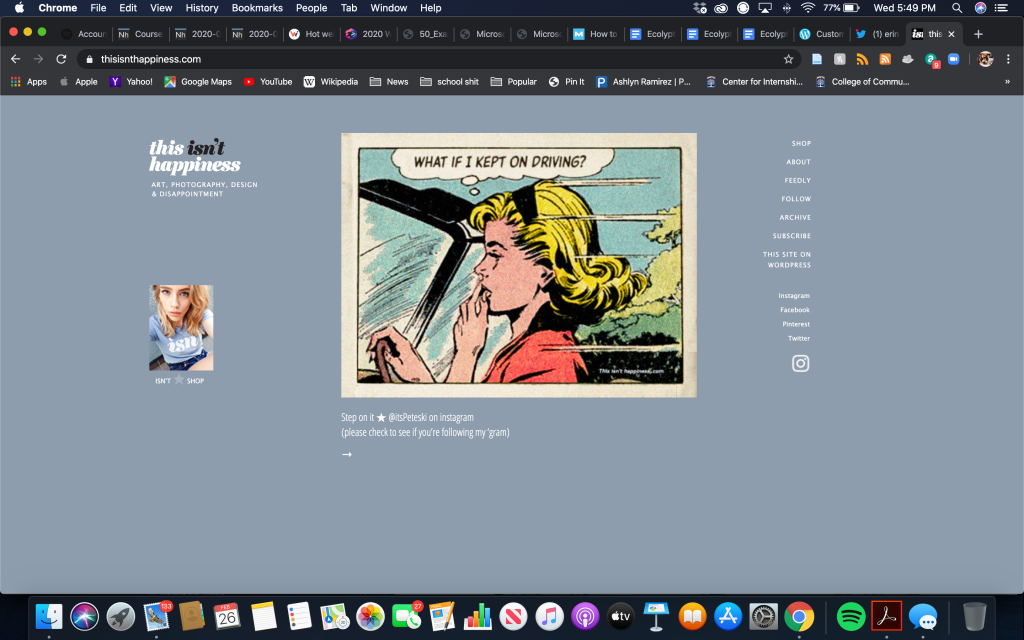
I know it’s going to sound crazy but I’m not big on following bloggers right now. I used to be huge on following artists on another platform we all know as Tumblr. It was mainly for the aesthetic and being able to talk through pictures. Sometimes, pictures being worth more than a thousand words is way better than actually having a thousand words to sift through.
For example, look at the blogger on Tumblr known as user ‘thisisnthappiness’:
A theme is consistently followed that draws people in that focuses heavily on the visual aspect. In short it’s all about showing, not exactly telling.
Their blog is on Tumblr, has its own separate domain and is transferred to WordPress. That means the reach as an artist online is subsequently global. For example, this blogger has been around long enough to maintain these platforms and even open up an e-commerce section to make money off of instead of advertisements.
The fact that simplicity can tell a story is something that consumers vie for when consuming content online is very telling. With the options that WordPress offers to their users, it’s clear that their model is pertinent to content creation in the future.
I’ve went from print journalism to marketing, public relations, advertising and back again. For now, I’m trying to stay in the social media manager realm because it allows me to write blogs.
Meaning I get to exercise my journalistic creativity on the regular. But seriously though, I cannot express enough how underpaid and undervalued I am as a content creator. I’m marketing a brand to retain clients and often I’m still stuck cleaning a break room.
How can I continue to create an organic outreach that reaches real customers when I’m not taken seriously?
This is why I’m in school. I’m kind of hoping that with the next tier of degree in my life, I’ll get taken a little more seriously. I want to help companies grow and I’m generally not given the resources or time to make that genuine connection happen.
Unfortunately living in the metropolitan area that would see my value in Southern California is a six-figure endeavor. I’m talking like, almost a quarter of a million dollars a year just spent on living comfortably.
And I’m not at that point in my life yet. I don’t know if I’ll ever be close. It seems like my generation really got the short end of the stick and somehow it was so bad that the impact has trickled down to literally everyone except the 1 percent.
Yeah, not at all surprising how the difference between minimum wage at $15000 annually vs $15/hr at $31000 annually is the cost of a car. Few of those a year with social media making it viral is some cheap ass cynical marketing.
Connecting to an audience in a prolific way is something that I crave. I constantly find myself reading these feel good stories but the problem here is that they’re all bandaids for some kind of poor practice. There’s better ways to connect to an audience.
I like to do it in writing because I have social anxiety. But then that anxiety took over my words too. Being in this program has really changed me. It’s caused me to become more humble but to also see that I’m worth more than minimum wage.
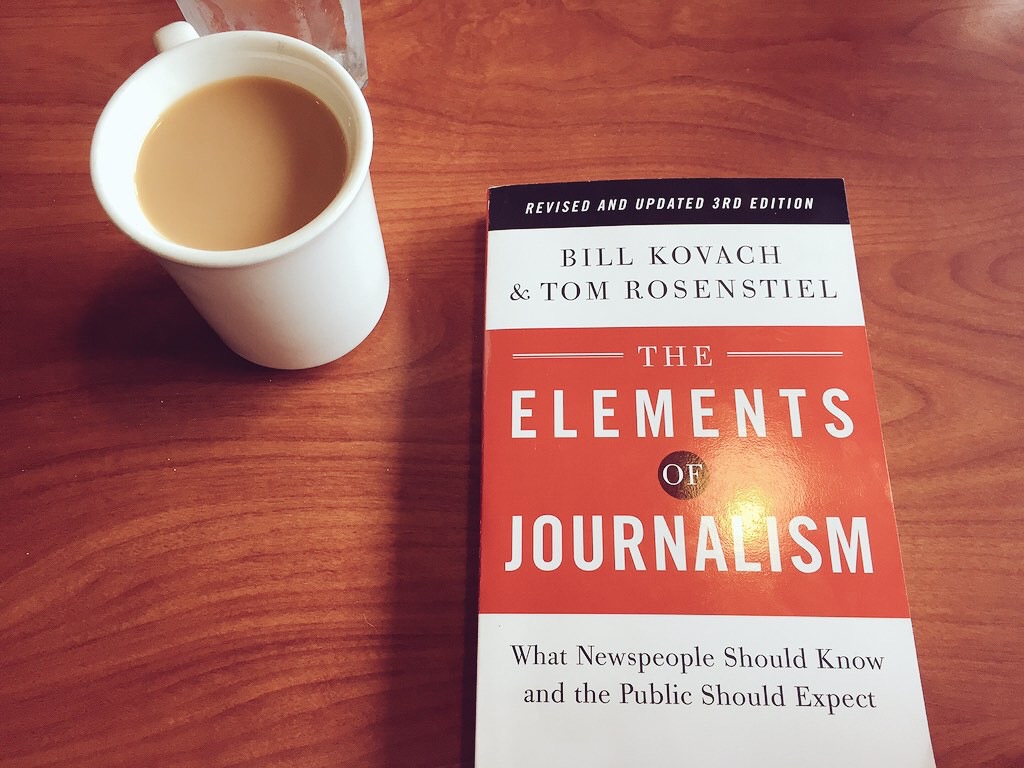
Journalism is the core of the communications field. The digital convergence that happens with public relations, marketing and advertising is propelled by media convergence. I have always felt like journalists are held to a higher standard than anyone else. This is because the public trusting us is vital to democracy.
We need to strive to do better. I will never not express how important it is to keep going for the optimum outcome. I know that not everyone in the Newhouse School is there for a journalism degree. Some might hate writing entirely. But when we all work together and pay mind to the ethics behind our careers, our lives are a little bit easier.
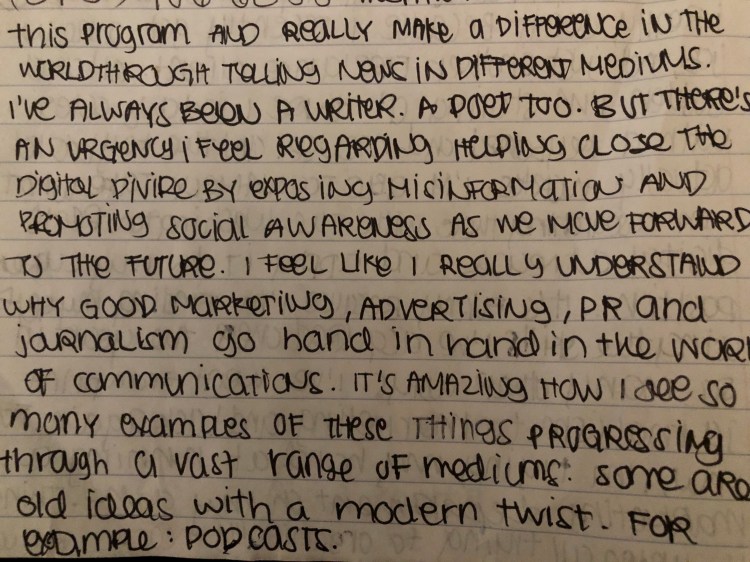
I hope I can take the inspiration I draw from this program and really make a difference in the world through telling news via different mediums. I’ve always been a writer. A poet too. But there’s an urgency I feel regarding closing the gap that is the digital divide by exposing misinformation and promoting social awareness as our whole world inches further into the future.
I feel like I really understand why good marketing, advertising, PR and journalism will always go hand in hand with each other. One cannot function without the other in our realm.
The amount of mediums is way too many to count and hard to keep track. Right now I’m loving podcasts because it’s a really old idea with a modern twist attached to it.
Multimedia is this whole different ballgame that really gives writers new and creative ways to tell the stories that they write. If journalists like myself can’t keep up with that, we’re going to slowly lose the media literacy we’ve grown to have.
Digital convergence isn’t going to stop, so we need to hop on the bandwagon and ensure that what does come out is used to the fullest extent of the product or service’s capabilities.
Having a free press is my everything. It’s a gift unlike any other. It’s used as a curse, in some situations. I respect it above all else though, always. If more people lose their respect towards this profession, we’re going to see more open hatred across the board.
I feel like so many demographics have been looked over until recently. And this new wave of marketing towards the younger generations through the likes of big data collection is super creepy. Highly intriguing to watch change happen so quickly though.
Who would’ve known that AARPANET would turn into this massive worldwide conglomerate that corporations are fighting to control the access to? A social awakening is happening that is only going to continue to grow.
As human behavior continues to change, we’re currently seeing something unlike anything that’s been recorded by historians before. It’s not Ancient Aliens or anything, but it’s still pretty great.
The ways culture is portrayed across the world is solely because the internet is here to allow for mass sharing. I’m all here for it. Let’s keep sending memes.
It’s so hard to say what else lies in the future. I’m kind of hoping that eventually I’ll have some brain implant that’ll allow a laptop to type my thoughts for me since my carpal tunnel will probably eventually take my hands out.
Other than that, all I can do is hope that there will be some regulations that will keep customization convenient and 75 percent less invasive. Wait no, maybe like 95 percent less invasive. I’m hoping for the best.
Kind of seems like we’re living in a dystopian universe already though. At least we’re all in this together, right?
Classes like this one have taught me a handful of useful tidbits for the future. I feel like this blog has also helped me express my feelings, opinions and what not to the best of my ability. All while getting to drop facts in between.
I’ve got a glorified diary. I plan on using it as much as I can.
I have to pre-write to write.
It’s insane how all of the topics discussed over the term are things I’ve already recognized in real life but never knew the proper terminology for. I’m so excited to continue learning.
As someone who suffers from massive anxiety to the point where I can’t check my email or grades, being able to free-flow while weaving in my understanding of class topics helps me truly get the stuff that I’m reading and watching.
I guess this is essentially the tip of the iceberg with the beginning of my graduate school career. I’m over here, hand writing my last blogs for this class while thinking about my finals. Stressing. Multimedia for one and a case study for another.
The thing that I’ve truly enjoyed about this course though is the way I can now analyze and tie in the importance of digital/media convergence. I can especially see it because I recently got a new job-which at the time of typing this bit I am probably going to never go back-and I happened to be in an office setting instead of being at home.
Totally new to me. Even this program is. But I do enjoy being able to still feel like I’m in a classroom learning, instead of trying to teach something myself with very little to no direction.
So last week, all of a sudden I was staring at three computer screens. Holy second screen experience! And a keyboard and a mouse that work! I’ve been working from a broken laptop for almost a year! This is nuts!
I was able to take what I’ve learned in journalism from my undergrad and what I’ve learned about journalism innovation at my short time at Syracuse and really do a lot of work in a short amount of time. It took me 57 hours, but I got them set up with social media posts across six platforms until the end of March.
It was easily enough work to earn a grand. Turns out they thought it was worth half of that. All of this work I put into this company to make them look good and it kind of wasn’t worth the effort.
Honestly though the fact that this client thought that it was okay to pay me California minimum wage is really the result of the lack of media literacy in the country. It’s super simple to look up the average wage of a social media manager in the United States.
Add in a copy editor and marketing/personal assistant to the mix and the costs add up. I digress, though.
I’m over here incredibly upset that I’m late on my work at a super crucial time but at the same time I’m grateful that the little bit I’ve taken from this program I’ve already learned how to use to further my career path.
And I got to really experience a true multi-screen experience for a little bit that I wouldn’t have before. Even if the client was lackluster, Syracuse got me there and helped me see my worth.
There’s always people that need someone to write and edit for them. Until then I’m going to write my little heart out on this blog and hope that it provides context into myself as a person.
I’ve seen what places like Vox and the Washington Post have done for journalism. I’m writing about the Washington Post for my case study. Those are things that can be applied to basically every aspect of communications. I’m constantly intrigued with the versatile manner that journalism fits within this broad industry.
However with the way things keep changing, it’s crucial to continue to revamp and rebrand the communications industry as a whole. Especially the media, both new and old.
I can’t express enough how amazing it is to take these skills that I’ve honed over the years and use them to better something else.
Considering how my alma matter is potentially shutting down the newspaper that I gained all of these skills from as a writer, I feel like the best way I can combat the reality of a dying newspaper by furthering my knowledge in multimedia. Period.
News needs to be told. We just have to understand the obstacles that we are dealt with.
Two years ago, I wrote the review for @Harry_Styles debut album for @thedailytitan and now I’m happy to support not only my favorite artist, but the student journalists behind this well-written review and the paper that helped me find my voice 🥰 https://t.co/hRgiEl6niV
Being able to connect to consumers is the best way to continue to close the digital divide. Now we just need WiFi accessible to everyone. I hope to see that in the near future. Everyone should have the opportunity to have access to a virtual library.
Without access to simple things like blogging, student journalism and student-ran communications groups across the nation, we will never be able to dominate in the media literacy field.
Student newspapers are vital and @thedailytitan is one of the best around. Many reporters you read began their careers at the DT. It needs to be kept alive. https://t.co/tygyYboFKP
I want to see a day where being a digital era journalist is considered just as important as any STEM major. I don’t think people understand how much goes into becoming an expert on a topic, hunting down verifiable sources and putting together a package that works across a multitude of platforms.
Being a watchdog is hard right now. It’s like trying to get an alcoholic to quit drinking when they just aren’t ready. But if we, as journalists, are able to gain trust and understanding, then the public might be ready to trust us later.
With the next round of presidential elections looming in the corner, I feel like finding new ways to innovate news and find news is more important than ever.















 All's Well That Ends Well