
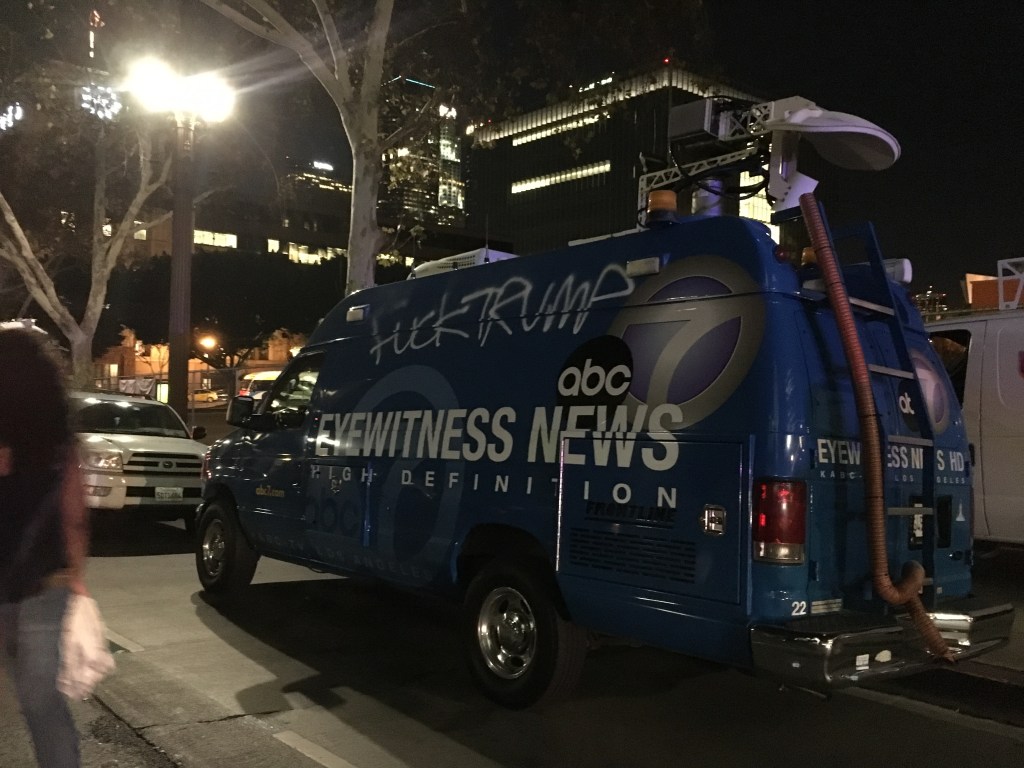
President Trump’s win over former Secretary of State and First Lady Hillary Rodham Clinton is something that has not only left a permanent distaste for diehard progressives– it’s also the cause of newfound yellow journalism.
But this is my opinion. Take it how you will.
Journalists are here to report the truth without bias. But the Trump Administration has hurled a cesspool of vitriol for the past three years at anyone who has questioned them.
People have been fired. People have been hurt because of misinformation. That damage is irreparable. Does this mean that journalism has become saturated?
No one thought that another country would pierce the soul of democracy here. Unfortunately that’s exactly what happened. And with the recent findings behind Trump trying to coax Ukraine’s president into another election fraud, journalists like me are wondering how this is going to impact the future later.
I read in one of my textbooks that over 200,000 journalists have been laid off since the early 2000’s. As far as this year goes, about 7,200 journalists have been laid off so far.
Once I joined the Daily Titan, Cal State Fullerton’s student newspaper, I was made well aware of how the term “fake news” would change my future.

Yes, I’ve been directly called this tasteless term, over this article linked here that I wrote. It’s insulting and dehumanizing as a student to see those leading your country effectively making your career more hostile and violent.
In fact, I had an entire Letter to the Editor written about a basic new piece I wrote almost three years ago. It was so crass that the editorial board heavily redacted it. We were flabbergasted. At this point, I can’t even find it online anymore. I guess it was that bad.
Part of this happened because I was a crucial asset to the editorial section–and also wrote countless opinion pieces that often denounced President Trump. The entire student body–or at least whoever read the paper– knew my name then. Speaking out as not only a journalist but a journalist of color has become increasingly harder over such a short period of time.
Writing those pieces has given me jobs. It’s also caused many to turn me away, especially in a part of California that isn’t even close to being blue. But even those that are blue can lack media literacy all the same.
Opinion is not news and it never has been. How much more can be done to inform a reader about what’s fact and what’s not?
Sure, you can throw a disclaimer on a piece. You can write that this is an opinion article. And it’s unlikely you’ll see an opinion piece grace the front page smack in the middle anyways.
However, you’re only going to see what your thoughts will allow. Just like those currently in power.
To this day, our President insists on attacking any news media that is not considered conservative. It’s disgusting and vile. It’s a very real threat to the First Amendment, our human rights and our democracy.
This is how the media became saturated to the point of a pop culture joke. Blogging exacerbated the lack of source credibility and those that aren’t fond of our country saw our weakness and took advantage of it. That’s why fighting back against “fake news” is more important than ever. But it’s a match that can only be strategically won.
No one knows everything. Even the media. That’s why objectivity and research are vital to make a sound, informed opinion. And then it’s time to spread information–fact checking is everything. Even if the current administration doesn’t care for any of it.
“Fake news” is a term that an entire newsroom will either laugh or roll their eyes at. But since the general public lacks the media literacy needed to really differentiate from what’s legitimate and what’s not, it’s a problem that has to be addressed through the next generations.
It’s going to take more than writing in your Twitter bio that your opinions don’t represent your work. Without passing down media literacy to the public, there’s no way journalism is going to ride out this wave.
It’s going to get messy. Even other countries are feeling the burn.
Trying to start a journalism career in a rapidly changing industry is hard enough. Once you add the threat of yellow journalism into the mix, things start to get more complicated. Combating a monster that was probably created through the acts of Russia and various Republican representatives was something no one ever thought would be a thing.
Now, what does this mean for future elections? The key to changing everything is awareness, facts and voting. Without any of these things, a president can become a tyrant. Just like how the government relies on checks and balances, journalists have to rely on their ethics. Everyone’s a skeptic. It’s a journalist’s job to localize and humanize their writing for the general public to pay attention.
I was taught to not even register to vote. Old school journalists take ethics to a level that isn’t really seen anymore. It’s something that future journalists must keep in mind. Times are changing with us, but our core stays the same. Yellow journalism has been around for quite some time and we, as journalists, have to get craftier at handling it.
Those that utilize the internet and social media to spread their views ultimately push credible sources out the window. It’s to the point where many people have become so skeptical that science isn’t even something they want to believe in.
This is a problem that can only be fixed with understanding reality.
The next time you see an aunt or uncle on Facebook posting links to bogus news sites, don’t call them out in person. If you can, teach through education. Not everyone is going to listen to sources that don’t cater to their needs, but there’s always a middle ground to stand on while defending yourself.
 All's Well That Ends Well